The HSK exam in the Netherlands (2026–2027 guide)
The HSK exam (汉语水平考试) is the official Chinese proficiency test for non-native speakers. This guide covers everything you need to take it in the Netherlands: the levels, the switch to HSK 3.0, where the test centres are, the 2026 dates and fees, the online test, and what really happens on exam day.
 By Zoey (Ziqiao Zang), Chinese teacher since 2011
I have prepared learners for every HSK level since 2011, and from 2022 I set up and managed an official HSK online test centre, organising exams for more than 250 candidates. This guide is what I wish every candidate read before registering. I update it every year, because dates, fees and formats change.
What is the HSK exam?
HSK stands for Hànyǔ Shuǐpíng Kǎoshì (汉语水平考试Hànyǔ Shuǐpíng Kǎoshì), literally “Chinese level test”. It is the official Chinese proficiency test for people whose first language is not Chinese, organised worldwide by Chinese Testing International (CTI) under China’s Center for Language Education and Cooperation. In English it is often called the HSK test or HSK examination; it is the Chinese equivalent of exams such as IELTS for English or DELF for French.
An HSK certificate is used for:
- University admission in China and for Chinese-taught programmes elsewhere;
- Scholarships, such as the Chinese Government Scholarship;
- Work: as proof of language skills for employers and, in China, as part of the work-permit assessment;
- Personal goals: a clear, external milestone for your learning.
The written HSK tests listening, reading and (from HSK 2 or 3) writing. Speaking is tested separately in the HSKK (汉语水平口语考试), the HSK speaking test.
HSK levels explained
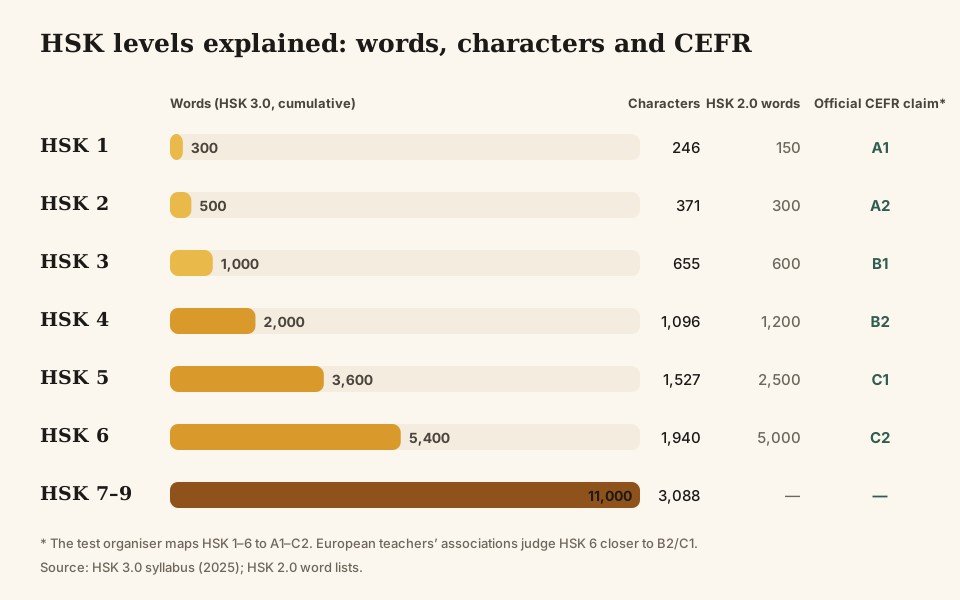
| Level | Band | Words (HSK 3.0, cumulative) | What you can do |
|---|---|---|---|
| HSK 1 | Elementary | ~300 | Introduce yourself, numbers, time, very simple questions |
| HSK 2 | Elementary | ~500 | Short everyday exchanges: shopping, directions, plans |
| HSK 3 | Elementary | ~1,000 | Handle daily life and travel; read simple texts without pinyin |
| HSK 4 | Intermediate | ~2,000 | Discuss a range of topics; follow most everyday conversations |
| HSK 5 | Intermediate | ~3,600 | Read newspapers and watch films; give a structured talk |
| HSK 6 | Intermediate | ~5,400 | Understand complex texts; express yourself fluently |
| HSK 7–9 | Advanced | ~11,000 | Academic and professional use; translation and interpreting tasks |
Each level has its own page with the full word list, grammar points and sample questions: HSK 1, HSK 2, HSK 3, HSK 4, HSK 5 and HSK 6.
HSKK: the speaking test
The HSKK has three levels: Elementary (for HSK 1–3 learners), Intermediate (HSK 4) and Advanced (HSK 5–6). It is recorded on a computer: you repeat sentences, describe pictures, answer questions, retell a passage and, at the higher levels, speak about a topic. At the Dutch test centres, candidates for HSK 3, 4, 5 and 6 have been registered for the matching HSKK at the same time since January 2025; the HSKK can also be taken on its own.
HSK and CEFR
The test organiser links HSK 1–6 to the European framework (CEFR) as A1 to C2. Many European teachers of Chinese, including the German and French associations, consider that too generous, because the old HSK 6 required “only” 5,000 words, and place HSK 6 closer to B2 or C1. A fair rule of thumb for the HSK CEFR question: HSK 3 ≈ A2/B1, HSK 4 ≈ B1, HSK 5 ≈ B2, HSK 6 ≈ B2/C1. The new HSK 3.0, with larger word lists, narrows that gap.
HSK 3.0: what is changing, and when
The new HSK has been coming since China published new Chinese proficiency standards in 2021. The advanced HSK 7–9 exam started in 2022. For levels 1–6, the official new syllabus was published in November 2025, a worldwide trial exam was held on 31 January 2026, and test centres are now switching over.
In the Netherlands: the Groningen Confucius Institute states that its September–November 2026 tests still use the current HSK 2.0 version and that HSK 3.0 is implemented from December 2026. Check your test centre’s page when you register, because this applies per test session.
What changes for candidates under HSK 3.0:
| HSK 2.0 (2010) | HSK 3.0 (2025 syllabus) | |
|---|---|---|
| Levels | 6 | 9 (1–6 separately, 7–9 as one exam) |
| HSK 1 vocabulary | 150 words | ~300 words |
| HSK 4 vocabulary | 1,200 words | ~2,000 words |
| HSK 6 vocabulary | 5,000 words | ~5,400 words |
| Characters | Not specified separately | Separate lists to recognise and to handwrite |
| Grammar | Implicit | Explicit list of grammar points per level |
In practice: every level is a little harder than its old namesake, especially HSK 1–4. Learners already preparing with the old lists should add the new vocabulary rather than start again. My HSK preparation course uses the HSK 3.0 lists for that reason.
Where to take the HSK exam in the Netherlands
There are two main organisers in the Netherlands.
Groningen Confucius Institute (GCI)
- Internet-based test (iBT): in Amsterdam. You answer on a computer at the test centre. In 2026 sessions were held on 22 March, 11 April, 16 May, 28 June, 13 September, 17 October, 7 November and 13 December.
- Paper-based test: in different cities each session. In 2026: Rotterdam (22 March), Wassenaar (11 April, HSK 1–2) and Groningen (11 April, HSK 3–6), Arnhem (16 May), Zwolle (28 June), Nijmegen (21 November) and Eindhoven (13 December).
- GCI has offices in Groningen, Amsterdam (Herengracht) and The Hague. Questions: hsktest@confuciusgroningen.nl.
Confucius Institute Maastricht
- Computer-based test for HSK 1–6 and the HSKK at the institute in Maastricht (Brusselseweg 150).
- 2026 second-half sessions: 7 November and 13 December.
Other organisations
Some Chinese schools also publish HSK registration notices, such as 丹华文化教育中心 (Danhua) in Rotterdam. Always confirm on chinesetest.cn that a test centre and date are official before you pay.
Paper, computer or at home?
| Format | How it works | Where in NL |
|---|---|---|
| Paper-based | Answer sheet and pencil (2B); you write characters by hand in the writing section | GCI, rotating cities |
| Internet-based (computer) | Questions on screen; you type characters using pinyin input | GCI in Amsterdam; CI Maastricht |
| Home edition | Taken at home with remote proctoring | Not offered by the Dutch centres |
So the answer to “can I take the HSK exam online?” is: yes, as an HSK online test on a computer, but at a test centre, not from home. For most learners the computer test is easier for writing, since typing pinyin is faster than handwriting, but you must recognise the correct character among the options.
HSK exam dates 2026 and 2027
Remaining sessions in 2026, as published by the test centres (always check before registering):
| Date | Organiser | Format and place | Registration deadline |
|---|---|---|---|
| 7 Nov 2026 | GCI | Internet-based, Amsterdam | 21 Oct 2026 |
| 7 Nov 2026 | CI Maastricht | Computer-based, Maastricht | 28 Oct 2026, 12:00 |
| 21 Nov 2026 | GCI | Paper-based, Nijmegen | 16 Oct 2026 |
| 13 Dec 2026 | GCI | Internet-based, Amsterdam | 26 Nov 2026 |
| 13 Dec 2026 | GCI | Paper-based, Eindhoven | 9 Nov 2026 |
| 13 Dec 2026 | CI Maastricht | Computer-based, Maastricht | 3 Dec 2026, 12:00 |
HSK exam dates 2027 had not yet been published by the Dutch centres at the time of writing (October 2026). In recent years the first sessions of the year have been in March and April, with several more before the summer and again in the autumn. I add the 2027 dates here as soon as they are announced. Spots for the internet-based test are limited, so register early.
How to register for the HSK test
- Create an account at chinesetest.cn (the official site of Chinese Testing International) with your details exactly as on your passport or ID card.
- Book a test: choose the test type (paper-based, or internet-based “at center”), the level, the date and the test centre, for example “Groningen Confucius Institute (iBT)”.
- Upload a photo: a recent, passport-style headshot in JPG or PNG within the size limits shown.
- Pay: GCI sends you an invoice to pay before the deadline; Maastricht asks you to buy the exam on its own website.
- Confirmation: about ten days before the test you receive a confirmation.
- Admission ticket: download and print it from chinesetest.cn about a week before the test.
- Exam day: bring the printed admission ticket and your original ID. Copies are not accepted, and without both you cannot sit the test.
That is the whole HSK test registration process. Cancellation rules (2026): more than 27 days before the test, full refund; 10 to 27 days before, 50 %; less than 10 days, no refund.
How much does the HSK exam cost?
| Test | GCI (2026) | CI Maastricht |
|---|---|---|
| HSK 1 | €27 | €25 |
| HSK 2 | €37 | €35 |
| HSK 3 + HSKK Elementary | €72 | €70 |
| HSK 4 + HSKK Intermediate | €107 | €105 |
| HSK 5 + HSKK Advanced | €137 | €135 |
| HSK 6 + HSKK Advanced | €147 | €145 |
| HSKK Elementary only | €27 | €25 |
| HSKK Intermediate only | €47 | €45 |
| HSKK Advanced only | €67 | €65 |
Maastricht charges €5.50 to post your certificate within the Netherlands (€9.50 within Europe), or you collect it. Exam fees are separate from any course fees. So the HSK exam cost is modest; the real investment is the preparation.
Results, certificates and validity
- Results: published online at chinesetest.cn, usually about a month after the test. You need your admission ticket number to check your HSK score.
- Certificate: sent to the test centre, then collected or posted to you.
- Pass mark: under HSK 2.0, HSK 1 and 2 are scored out of 200 (pass: 120), HSK 3–6 out of 300 (pass: 180). Check the new syllabus for HSK 3.0 scoring.
- Validity: for admission to Chinese universities, an HSK score is generally accepted for two years from the test date. The certificate itself does not expire.
What happens on exam day: an insider’s view
Having run an online test centre, I have watched hundreds of candidates go through exam day. This is what to expect in the internet-based test:
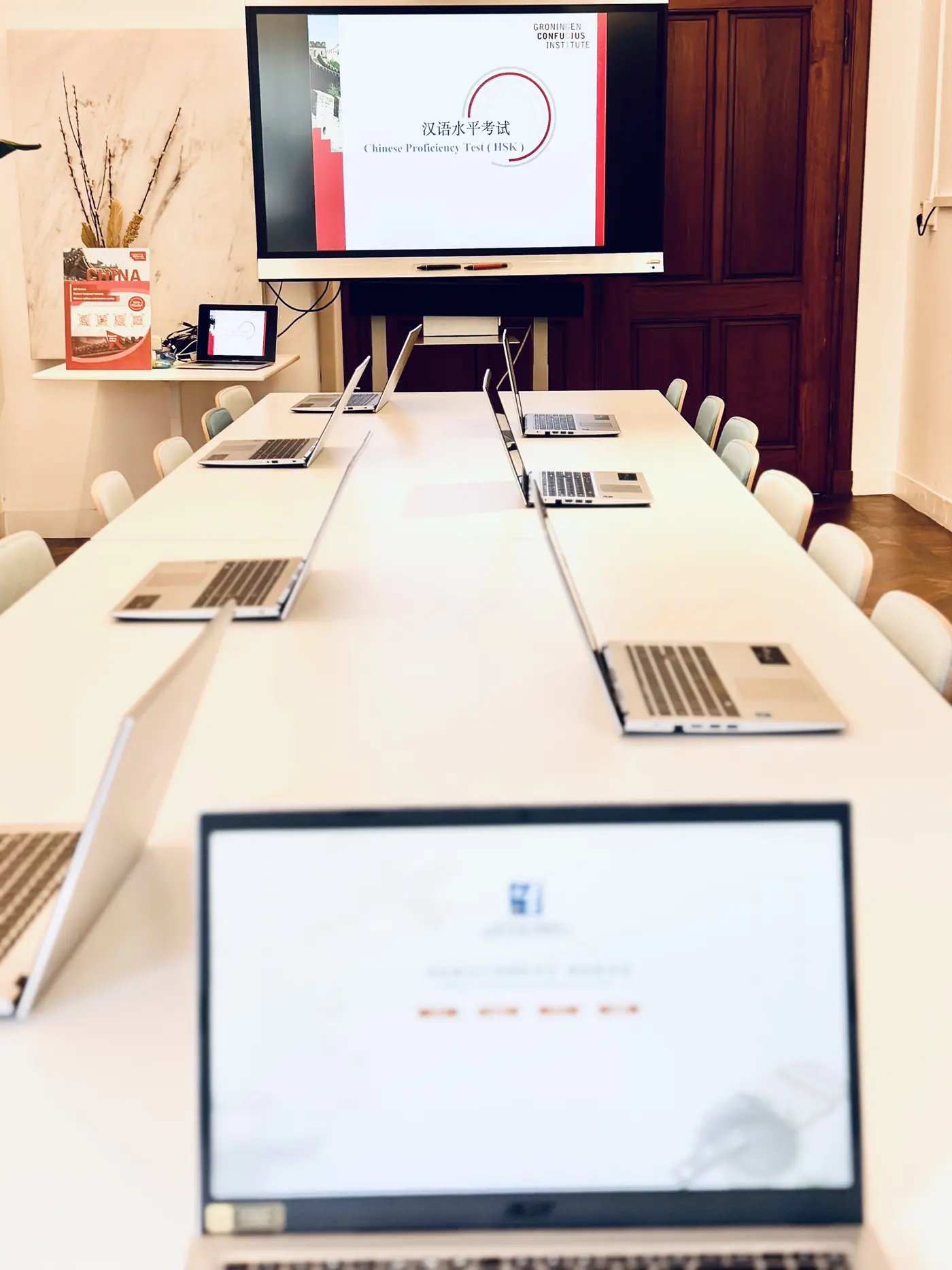
- Arrival. Be there 30 minutes early. Staff check your admission ticket and ID; coats, bags and phones go to a separate area. Late arrivals are not admitted once the listening section starts.
- Seat and login. You sit at an assigned computer with headphones. The invigilator explains the procedure; you log in with the details on your ticket and check your name and photo.
- Sound check. You test the headphones. If the volume is wrong, raise your hand now, not halfway through the listening.
- Listening. The recordings play automatically. You cannot pause or replay them. Use the seconds between items to read the next answer options.
- Reading. You control the pace. A timer counts down in the corner of the screen: watch it, and do not get stuck on one question.
- Writing (from HSK 3 in the old format). You type in pinyin and choose characters from a list. Check each word: homophones are the most common lost points.
- HSKK (for HSK 3–6 candidates). After a break you put on a headset with a microphone and record your answers. Speak clearly and keep going; silence scores nothing.
Is the HSK worth it?
For study or work, the HSK is the internationally recognised proof of your Chinese, and often required. For personal learning, it gives your study a clear goal and a deadline, which keeps many adults going. But it is not a measure of everything: an HSK 4 candidate who has only studied for the test can find a real conversation harder than someone without a certificate who speaks every week. The best preparation combines both: exam technique and real communication. Read how long it takes to learn Chinese to plan a realistic timeline.
Prepare for the HSK with a teacher who knows the exam
My HSK preparation course covers HSK 1–6 and the HSKK, online or in Amsterdam, with timed mock tests on screen and on paper. Whether you are preparing for the HSK exam in Amsterdam or in Maastricht, you can send me an enquiry with your level and target date.
Frequently asked questions
How much does an HSK exam cost in the Netherlands?
In 2026 the Groningen Confucius Institute charges €27 for HSK 1, €37 for HSK 2, €72 for HSK 3 with HSKK, €107 for HSK 4 with HSKK, €137 for HSK 5 and €147 for HSK 6, each with HSKK. Confucius Institute Maastricht charges €25 to €145 for the same tests, plus postage if your certificate is sent to you.
When can I register for the HSK test in 2026?
Registration usually opens about two months before each test date and closes roughly two to five weeks before it. For the last 2026 sessions: Groningen Confucius Institute's internet-based test in Amsterdam on 13 December closes on 26 November, and Maastricht's 13 December test closes on 3 December at noon. Register at chinesetest.cn.
Can I take the HSK test online?
You can take the internet-based HSK, answered on a computer, but in the Netherlands it is taken at a test centre, not at home. The Groningen Confucius Institute holds it in Amsterdam and Confucius Institute Maastricht in Maastricht. A home edition is not offered by the Dutch centres, so plan to travel to the test venue.
How many HSK levels are there?
HSK 3.0 has nine levels in three bands: elementary (HSK 1–3), intermediate (HSK 4–6) and advanced (HSK 7–9). Levels 1 to 6 are separate exams; 7 to 9 are tested together in one exam. There is also a separate speaking test, the HSKK, at elementary, intermediate and advanced level.
Is the HSK worth it?
If you need proof of your Chinese for study, work or a scholarship, yes: it is the internationally recognised certificate. For personal learning it is a useful goal that gives your study structure and a deadline. It is not essential for travel or for speaking with friends, and passing an exam is not the same as fluent conversation.
What HSK level do I need to work in China?
It depends on the job and employer. Many employers in China treat HSK 4 as a practical minimum for working in Chinese, and HSK 5 or 6 for roles that involve reading documents or negotiating. Chinese universities commonly ask for HSK 4 or higher for Chinese-taught degree programmes. Always check the specific employer's or university's requirement.
Prepare for the HSK with Zoey
One-to-one or small-group HSK preparation, online or in Amsterdam, from the teacher who set up and ran an official HSK online test centre.
Keep reading
-
HSK preparation
Targeted preparation for HSK 1–6 and HSKK, including the new HSK 3.0.
-
HSK 1
Word list, grammar, exam format and sample questions.
-
HSK 4
Word list, grammar, exam format and sample questions.
-
How long does it take to learn Chinese?
Realistic hours per HSK level, what is hard, what is easy, and a 12-month plan.
About the author
Zoey (Ziqiao Zang, 臧子乔) has taught Chinese as a foreign language since 2011 and in the Netherlands since 2016. She holds a Master of Teaching Chinese to Speakers of Other Languages from Zhejiang Normal University and set up and ran an official HSK online exam centre with more than 250 candidates.