Business Chinese for professionals and teams
Business Chinese lessons for people who work with Chinese clients, suppliers, investors or colleagues. One-to-one or as in-company training for your team, in Amsterdam or online, built around your sector, your meetings and the conversations that matter for your business.
 By Zoey (Ziqiao Zang), Chinese teacher since 2011
China is one of the Netherlands’ largest trading partners, and the Port of Rotterdam, Schiphol and many Dutch tech and agri-food companies deal with Chinese partners every day. Most of that business runs in English. But the professionals who can greet a delegation in Mandarin, follow the small talk at dinner or understand what 你看着办nǐ kànzhe bàn really means when a manager says it, build trust faster. That is what Chinese for business is about: not replacing your interpreter, but understanding the people across the table.
Who business Chinese lessons are for
- Professionals who travel to China, host Chinese visitors or work in a team with Chinese colleagues.
- Teams in trade, logistics, technology, engineering, agri-food, design or law that need a shared basic level and cultural awareness.
- Managers preparing for a posting in China or Taiwan.
- Entrepreneurs sourcing from or selling to China who want more direct contact with suppliers and partners.
- Advanced learners who already speak good everyday Chinese and want advanced business Chinese: formal register, presentations and written communication.
Lessons take place in-company in Amsterdam or online, one-to-one or in small groups. For teams spread across offices, online corporate Chinese training keeps everyone on the same programme.
What you learn in a business Chinese course
Sector vocabulary
Every business Chinese course at KeSong is built around your field. A few examples of the vocabulary different teams start with:
| ▶ | Characters | Pinyin | Meaning | Sector |
|---|---|---|---|---|
| 报价 | bàojià | quotation, to quote a price | Trade | |
| 交货期 | jiāohuòqī | delivery time | Trade | |
| 集装箱 | jízhuāngxiāng | shipping container | Logistics | |
| 清关 | qīngguān | customs clearance | Logistics | |
| 研发 | yánfā | research and development | Tech | |
| 知识产权 | zhīshi chǎnquán | intellectual property | Tech / Legal | |
| 合同 | hétong | contract | Legal | |
| 条款 | tiáokuǎn | clause, terms | Legal |
Meetings and presentations
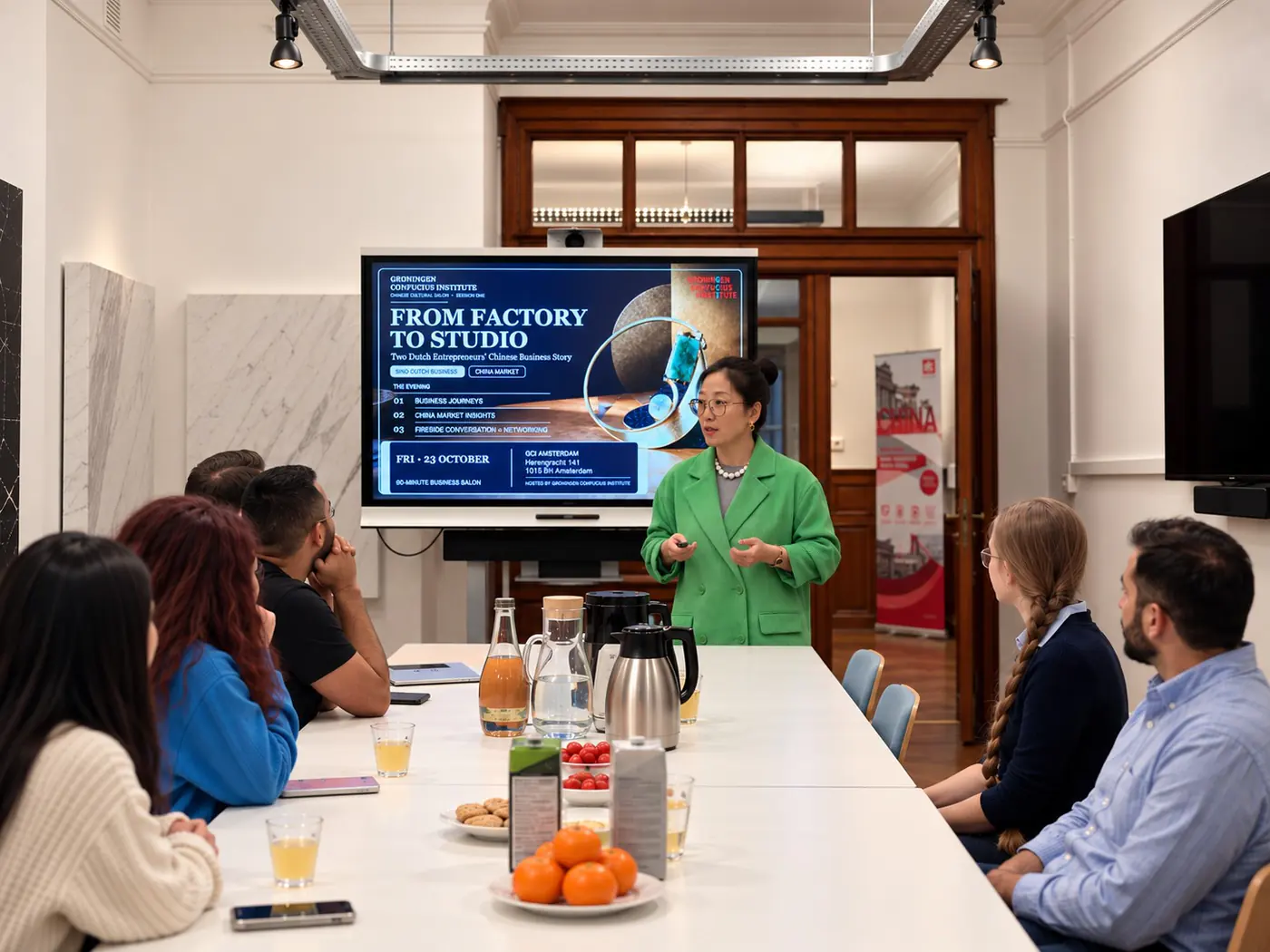
Opening a meeting politely, introducing your company, presenting numbers, agreeing next steps. You learn the fixed phrases Chinese partners expect, such as 感谢各位的到来gǎnxiè gèwèi de dàolái (“thank you all for coming”), and how to sound respectful rather than translated.
Email and messaging
A lot of business with China happens on WeChat and in email. You learn the formulas for greetings and closings, how to make a request politely, and how to read the tone of a short reply. A WeChat message that just says 在吗?zài ma? means more than “are you there?”.
Negotiation
Making an offer, asking for a discount, saying no without saying no. Chinese negotiation style often values indirectness and face; phrases like 我们再研究一下wǒmen zài yánjiū yíxià (“we will look into it further”) can be a polite refusal. Understanding that saves misunderstandings.
The video loads from YouTube when you press play.
Culture module
Language without culture leads to awkward moments. The culture module covers business cards, seating, banquets and toasting, gift-giving, hierarchy and the concepts of face (面子miànzi) and relationships (关系guānxi). Read the introduction in Chinese business etiquette. For company events, the culture module can also take the form of a culture workshop, for example around Chinese New Year.
How a tailored programme is built
- Intake. A conversation with you (or with HR and the team lead) about goals, situations and timing. Who meets Chinese partners, how often, in what roles?
- Level check. Participants with previous Chinese do a short placement assessment.
- Programme design. Zoey proposes a programme: number of sessions, topics in order, group composition and materials. Teams with mixed levels can combine a group session with short individual sessions.
- Lessons. In-company in Amsterdam or online, at times that fit the working week, for example a weekly lunchtime session.
- Review. Progress is reviewed with participants (and, if agreed, with the company) at set moments, and the programme adjusted.
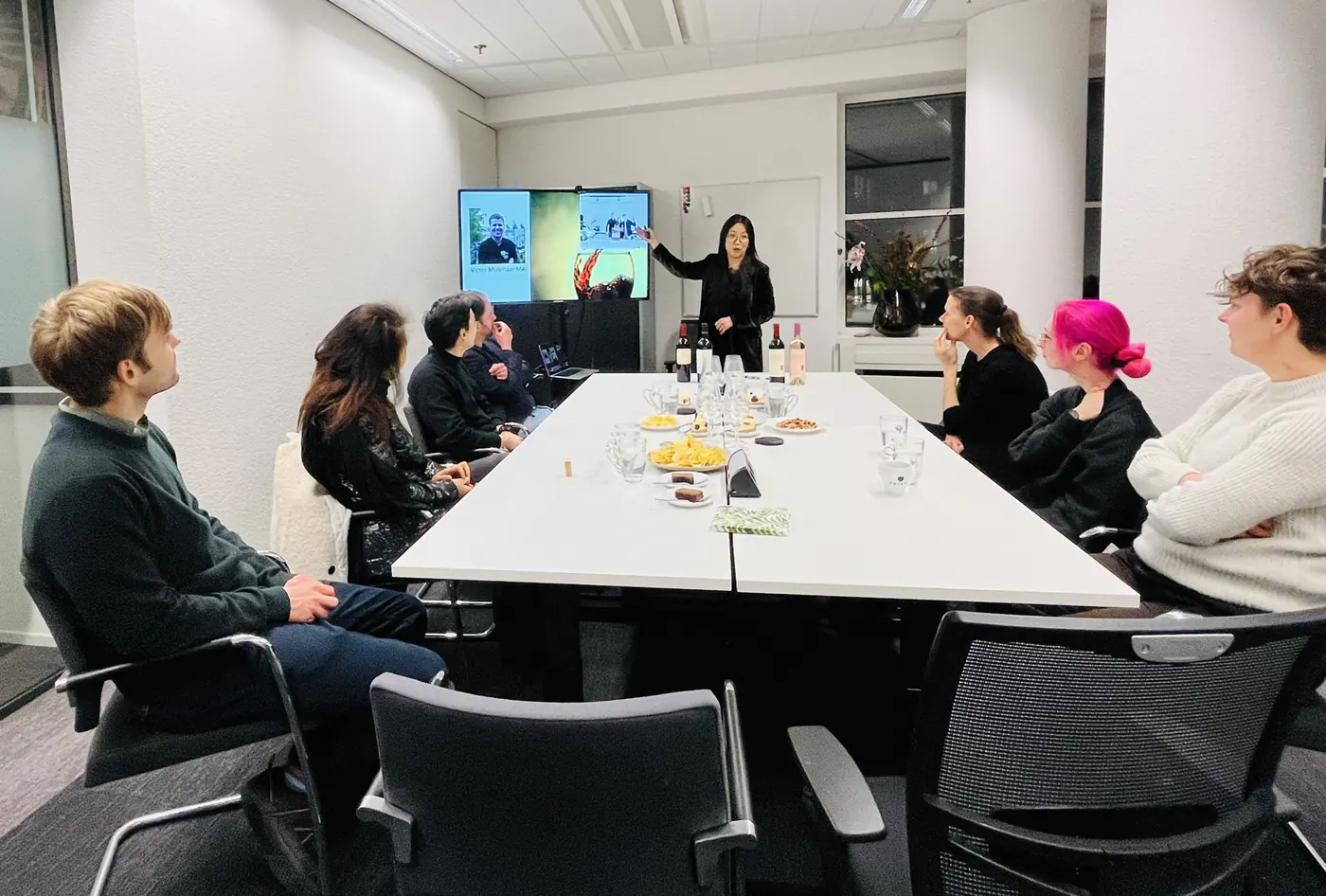
Group fees for in-company Chinese training depend on the number of participants and are confirmed after the placement assessment. Individual lessons cost €60 per hour.
What is the best Chinese to learn for business?
For almost all business purposes the answer is Mandarin (普通话 Pǔtōnghuà), written in simplified characters. Mandarin is the official language of mainland China and the language of business across the country, from Shanghai to Shenzhen. It is also an official language in Taiwan (with traditional characters) and Singapore. Cantonese is the everyday language of Hong Kong and much of Guangdong, but business Mandarin is widely used there too. If your partners are mainly in Hong Kong, it is worth discussing; otherwise, start with Mandarin. Read more in Mandarin vs Cantonese.
How to learn Chinese for business purposes
The most effective route combines a general foundation with work-specific practice from the start:
- Months 1–3: pinyin, tones, introductions, numbers, dates and prices; polite phrases for meetings and dinners.
- Months 4–12: everyday conversation (around HSK 2–3), plus your own sector vocabulary and simple email formulas.
- Year 2 and beyond: meetings, presentations and negotiation phrases (HSK 4 and up); reading short documents; the BCT (商务汉语考试) or HSK as a certificate if useful.
Experienced professionals often set a realistic goal: enough Chinese to build relationships and follow what is happening, with an interpreter for complex negotiations. That goal is reachable in months, not years, and it changes how partners see you. To learn business Chinese effectively, you need lessons that are about your work from week one.
Why train with Zoey
Zoey worked for nine years at the Groningen Confucius Institute as a curriculum developer and instructional designer, designing Chinese programmes for more than 2,000 students, and now teaches at UvA Talen as well as at KeSong. She plans Chinese language training for companies the same way: from the situations people actually face at work. Her own YouTube series on workplace Chinese explains the high-context communication that textbooks skip. For business Chinese in the Netherlands, that combination of language teaching and cultural explanation is what makes the lessons useful at work.
Interested in a business Mandarin course for yourself or your team? Send an enquiry describing the team, the goals and the timing, and Zoey will propose a programme.
Frequently asked questions
What is the best Chinese language to learn for business?
Mandarin (Putonghua), written in simplified characters. It is the official language of mainland China, used in business across the country and understood in Taiwan and Singapore. Cantonese is useful mainly in Hong Kong and parts of Guangdong, and even there Mandarin is widely spoken in business today.
How can I learn Chinese for business purposes?
Combine a solid general foundation with business-specific practice. Learn pinyin, tones and the core vocabulary first, then add the language of your own work: introductions, meetings, numbers and prices, email, negotiation phrases and the cultural rules behind them. A teacher can build that programme around your sector and real situations.
How long does it take to learn business Chinese?
For polite introductions, small talk at dinner and basic meeting phrases, a few months of regular lessons is enough. Working in Chinese, such as running a meeting or reading a contract summary, typically needs HSK 4–5 level, which takes most adults several years. Many professionals choose a realistic middle goal and use interpreters for the complex parts.
Do you offer in-company Chinese training?
Yes. In-company training can take place at your office in Amsterdam or online for teams spread across locations. The programme is designed with you: who needs what level, which situations matter, and how much time people can realistically spend. Group fees depend on the number of participants.
Is there a Chinese business language exam?
Yes, the BCT (Business Chinese Test, 商务汉语考试), organised by the same body as the HSK. Many employers simply ask for an HSK level instead. Zoey can prepare you for either, depending on what your employer or partner expects.
Learn with Zoey
One-to-one or in a small group, online or in Amsterdam by arrangement. Tell Zoey what you want to achieve and she will suggest a plan.
Keep reading
-
Chinese business etiquette
Business cards, meetings, dinners, toasts and guanxi, explained by a teacher.
-
Culture workshops
Calligraphy, Chinese New Year and paper-cutting workshops for teams and organisations.
-
HSK preparation
Targeted preparation for HSK 1–6 and HSKK, including the new HSK 3.0.
-
Online lessons
Live one-to-one or small-group lessons on Zoom, from anywhere.
About the author
Zoey (Ziqiao Zang, 臧子乔) has taught Chinese as a foreign language since 2011 and in the Netherlands since 2016. She holds a Master of Teaching Chinese to Speakers of Other Languages from Zhejiang Normal University and set up and ran an official HSK online exam centre with more than 250 candidates.