HSK 2 vocabulary, grammar and exam guide
HSK 2 takes you from introducing yourself to managing everyday life: shopping, making plans, talking about what you did and what you have experienced. Under HSK 3.0 it adds about 200 words to HSK 1, for a total of around 500. Here you find the complete HSK 2 word list with audio, the new grammar, the exam format and sample questions.
 By Zoey (Ziqiao Zang), Chinese teacher since 2011
What HSK 2 means
At HSK 2 you can handle short, simple exchanges on familiar topics: buying a train ticket, asking for directions, arranging to meet a friend, describing your weekend. The test organiser links it to CEFR A2. This is the level where Chinese starts to feel useful in daily life, and where many learners first understand a real conversation between two Chinese speakers, at least in part.
| HSK 2 | |
|---|---|
| New words (HSK 3.0) | about 200 |
| Total words (HSK 3.0) | about 500 |
| Characters to recognise (cumulative) | about 370 |
| Characters to write by hand (HSK 3.0) | about 100 |
| Skills tested (current format) | listening, reading |
| Exam length (current format) | about 50–55 minutes |
| Pass mark (current format) | 120 of 200 |
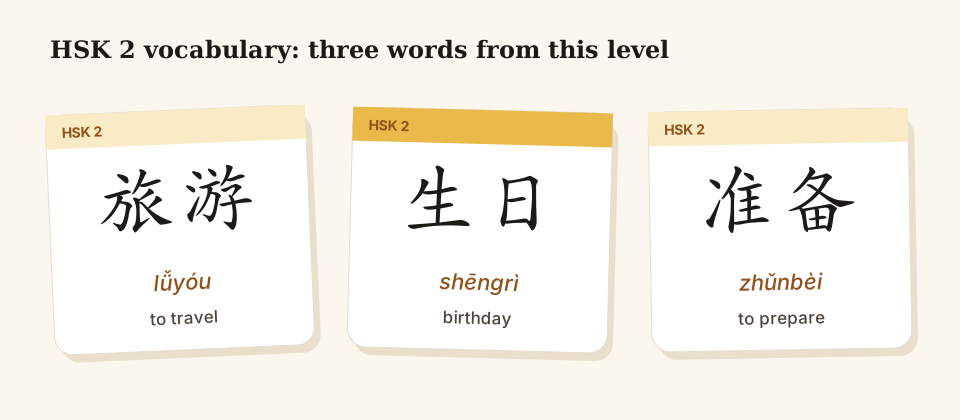
The HSK 2 exam format
| Part | Questions | Time | What you do |
|---|---|---|---|
| Listening | 35 | about 25 min | Pictures and short dialogues: true/false, matching, choosing the right answer to a question about a dialogue. Each recording plays twice. |
| Reading | 25 | about 22 min | Match sentences to pictures, fill in the right word, judge whether a statement matches a sentence, match questions and answers. Pinyin is still shown. |
HSK 2 is taken without the HSKK. See the HSK exam guide for test centres, dates and fees in the Netherlands.
Sample HSK 2 questions
Listening (dialogue). Woman: 你去过中国吗?Nǐ qùguo Zhōngguó ma? Man: 去过两次,都是去旅游。Qùguo liǎng cì, dōu shì qù lǚyóu. Question: why did the man go to China? A for work · B to study · C to travel. Answer: C.
Reading (fill the gap). 我比我哥哥 ___ 两岁。 A 小 · B 少 · C 短. Answer: A, “I am two years younger than my older brother.”
Reading (true or false). 我已经吃过饭了,不跟你们一起去饭馆了。 ★ 他还没吃饭。 Answer: false; he has already eaten.
HSK 2 grammar points
HSK 2 adds the grammar that lets you talk about time, change and experience:
- 了 le for a change of situation: 下雨了。Xià yǔ le. “It’s started raining.”
- 过 guo for experience: 我去过上海。Wǒ qùguo Shànghǎi. “I have been to Shanghai.”
- 着 zhe for an ongoing state: 门开着。Mén kāizhe. “The door is open.”
- 正在…呢 for actions in progress: 我正在吃饭呢.
- Comparisons with 比 bǐ: 今天比昨天冷。Jīntiān bǐ zuótiān lěng.
- Degree complements with 得 de: 他跑得很快。Tā pǎo de hěn kuài. “He runs fast.”
- 快要…了 / 就要…了: something is about to happen: 快要下雨了.
- 已经…了: already: 我已经到了.
- 因为…所以…: because … so …
- 虽然…但是…: although … (but) …
- 还是 háishi in questions (“or”): 你喝茶还是咖啡?
- 离 lí for distance: 我家离公司很近。Wǒ jiā lí gōngsī hěn jìn.
- 从…到… for from … to …
- 让 ràng for “let / make someone do”: 老师让我们复习.
- Verb reduplication to soften a request: 你看看, 我们休息休息.
On my other YouTube channel, Chinese Step by Step, I explain the first HSK 2 lesson in full, with 要, 最, 几 and 多:
The video loads from YouTube when you press play.
The complete HSK 2 vocabulary list
The words below are the ones new at HSK 2 in the HSK 3.0 syllabus; you also need all HSK 1 words.
197 new words at HSK 2 · Click a word to hear it. · Download the HSK 2 word list (CSV, opens in Excel or Numbers)
| Word | Pinyin | Meaning |
|---|---|---|
| 啊 | a | ah, oh (interjection) |
| 爱好 | àihào | hobby; to be fond of |
| 白色 | báisè | white |
| 班 | bān | class, shift |
| 帮 | bāng | to help |
| 帮忙 | bāng máng | to help, do a favour |
| 包 | bāo | bag; to wrap |
| 本子 | běnzi | notebook |
| 比 | bǐ | than; to compare |
| 笔 | bǐ | pen |
| 别 | bié | don't; other |
| 不错 | búcuò | not bad, pretty good |
| 不好意思 | bù hǎoyìsi | sorry, excuse me |
| 长 | cháng | long |
| 车站 | chēzhàn | station, stop |
| 出 | chū | to go out |
| 床 | chuáng | bed |
| 出国 | chū guó | to go abroad |
| 出来 | chūlai | to come out |
| 出门 | chū mén | to go out |
| 出去 | chūqu | to go out |
| 词 | cí | word |
| 次 | cì | time(s), occurrence |
| 从 | cóng | from |
| 从小 | cóngxiǎo | since childhood |
| 错 | cuò | wrong; mistake |
| 打 | dǎ | to hit; to play (sports) |
| 打车 | dǎ chē | to take a taxi |
| 打开 | dǎkāi | to open |
| 但 | dàn | but |
| 但是 | dànshì | but, however |
| 得 | de | (complement particle) |
| 地 | de | (adverb particle) -ly |
| 等 | děng | to wait |
| 地铁 | dìtiě | underground, metro |
| 懂 | dǒng | to understand |
| 动 | dòng | to move |
| 饭馆 | fànguǎn | restaurant |
| 飞 | fēi | to fly |
| 高 | gāo | tall, high |
| 告诉 | gàosu | to tell |
| 高中 | gāozhōng | senior high school |
| 跟 | gēn | with; to follow |
| 个子 | gèzi | height, build |
| 公交车 | gōngjiāochē | bus |
| 过 | guò | to pass; (experience particle) |
| 过来 | guòlai | to come over |
| 过年 | guò nián | to celebrate New Year |
| 过去 | guòqù | past; to go over |
| 还是 | háishi | or (in questions); still |
| 黑色 | hēisè | black |
| 红茶 | hóngchá | black tea |
| 红色 | hóngsè | red |
| 后面 | hòumiàn | behind, at the back |
| 花 | huā | flower; to spend |
| 画 | huà | to draw; painting |
| 坏 | huài | bad; broken |
| 回来 | huílai | to come back |
| 回去 | huíqu | to go back |
| 间 | jiān | (measure word for rooms) |
| 教 | jiāo | to teach |
| 教室 | jiàoshì | classroom |
| 机场 | jīchǎng | airport |
| 记得 | jìde | to remember |
| 介绍 | jièshào | to introduce |
| 近 | jìn | near, close |
| 进 | jìn | to enter |
| 经常 | jīngcháng | often |
| 进来 | jìnlai | to come in |
| 进去 | jìnqu | to go in |
| 机票 | jīpiào | plane ticket |
| 就 | jiù | then; just; right away |
| 酒店 | jiǔdiàn | hotel |
| 咖啡 | kāfēi | coffee |
| 开始 | kāishǐ | to begin |
| 开学 | kāi xué | school term starts |
| 考 | kǎo | to take an exam |
| 考试 | kǎoshì | exam; to take an exam |
| 可能 | kěnéng | possible; maybe |
| 快 | kuài | fast; soon |
| 快乐 | kuàilè | happy |
| 快要 | kuàiyào | about to |
| 裤子 | kùzi | trousers |
| 篮球 | lánqiú | basketball |
| 累 | lèi | tired |
| 离 | lí | from (distance) |
| 里面 | lǐmiàn | inside |
| 楼 | lóu | building; floor |
| 路 | lù | road |
| 绿茶 | lǜchá | green tea |
| 绿色 | lǜsè | green |
| 路上 | lùshang | on the way |
| 旅游 | lǚyóu | to travel; tourism |
| 慢 | màn | slow |
| 每 | měi | every, each |
| 没意思 | méi yìsi | boring |
| 门 | mén | door |
| 门口 | ménkǒu | entrance, doorway |
| 门票 | ménpiào | entrance ticket |
| 面 | miàn | side; face; noodles |
| 名 | míng | name; (measure word for people) |
| 拿 | ná | to take, to hold |
| 奶茶 | nǎichá | milk tea |
| 奶奶 | nǎinai | grandmother (father's mother) |
| 那么 | nàme | so, like that; then |
| 男孩儿 | nánháir | boy |
| 那样 | nàyàng | that way, like that |
| 鸟 | niǎo | bird |
| 女孩儿 | nǚháir | girl |
| 旁边 | pángbiān | next to, beside |
| 跑 | pǎo | to run |
| 跑步 | pǎobù | to go running |
| 票 | piào | ticket |
| 前面 | qiánmiàn | in front |
| 起来 | qǐlai | to get up; (start of action) |
| 晴 | qíng | sunny, clear |
| 球 | qiú | ball |
| 妻子 | qīzi | wife |
| 让 | ràng | to let; to ask (someone to) |
| 肉 | ròu | meat |
| 商场 | shāngchǎng | shopping centre |
| 上来 | shànglai | to come up |
| 上面 | shàngmiàn | on top, above |
| 上去 | shàngqu | to go up |
| 上网 | shàng wǎng | to go online |
| 生日 | shēngrì | birthday |
| 身体 | shēntǐ | body; health |
| 时 | shí | time; hour |
| 事情 | shìqing | matter, thing |
| 手 | shǒu | hand |
| 手表 | shǒubiǎo | wristwatch |
| 书包 | shūbāo | school bag |
| 舒服 | shūfu | comfortable |
| 送 | sòng | to give; to deliver; to see off |
| 虽然 | suīrán | although |
| 所以 | suǒyǐ | so, therefore |
| 疼 | téng | painful, to hurt |
| 踢 | tī | to kick |
| 题 | tí | question (in an exam) |
| 条 | tiáo | (measure word for long things) |
| 跳舞 | tiào wǔ | to dance |
| 头 | tóu | head |
| 外国 | wàiguó | foreign country |
| 外面 | wàimiàn | outside |
| 完 | wán | to finish |
| 万 | wàn | ten thousand |
| 往 | wǎng | towards |
| 忘 | wàng | to forget |
| 网上 | wǎngshàng | online |
| 位 | wèi | (polite measure word for people) |
| 为什么 | wèi shénme | why |
| 洗 | xǐ | to wash |
| 下来 | xiàlai | to come down |
| 下面 | xiàmiàn | below, under |
| 笑 | xiào | to laugh, to smile |
| 小孩儿 | xiǎoháir | child |
| 小时候 | xiǎo shíhou | in childhood |
| 下去 | xiàqu | to go down; to continue |
| 姓 | xìng | surname; to be surnamed |
| 姓名 | xìngmíng | full name |
| 洗手间 | xǐshǒujiān | toilet, restroom |
| 希望 | xīwàng | to hope; hope |
| 眼睛 | yǎnjing | eye |
| 颜色 | yánsè | colour |
| 药 | yào | medicine |
| 药店 | yàodiàn | pharmacy |
| 爷爷 | yéye | grandfather (father's father) |
| 一会儿 | yíhuìr | a moment |
| 已经 | yǐjīng | already |
| 阴 | yīn | overcast, cloudy |
| 因为 | yīnwèi | because |
| 一起 | yìqǐ | together |
| 意思 | yìsi | meaning |
| 游 | yóu | to swim; to tour |
| 右 | yòu | right (direction) |
| 右边 | yòubian | right side |
| 有时 | yǒushí | sometimes |
| 有意思 | yǒu yìsi | interesting, fun |
| 游泳 | yóu yǒng | to swim |
| 鱼 | yú | fish |
| 远 | yuǎn | far |
| 运动 | yùndòng | sport, exercise |
| 站 | zhàn | station; to stand |
| 丈夫 | zhàngfu | husband |
| 着 | zhe | (particle: ongoing state) |
| 这么 | zhème | so, like this |
| 正 | zhèng | just (now); straight |
| 这样 | zhèyàng | this way, like this |
| 周 | zhōu | week |
| 准备 | zhǔnbèi | to prepare |
| 自己 | zìjǐ | oneself |
| 走 | zǒu | to walk; to leave |
| 走路 | zǒu lù | to walk |
| 最 | zuì | most |
| 左 | zuǒ | left |
| 左边 | zuǒbian | left side |
| 足球 | zúqiú | football |
The video loads from YouTube when you press play.
How long does it take to prepare for HSK 2?
From zero, plan 160–240 hours in total; after HSK 1, about another 80–120 hours. With two lessons a week that is roughly six to nine months from the start, or three to five months after HSK 1. Read the full timeline in how long it takes to learn Chinese.
After HSK 2
HSK 3 is the level where you read without pinyin, write your first sentences and take the HSKK speaking test for the first time. If you want guidance on the way, see the HSK preparation course.
Word list: the official HSK 3.0 vocabulary (2025 syllabus), as compiled in the open complete-hsk-vocabulary project (MIT licence). Pinyin checked and meanings written by KeSong Chinese.
Frequently asked questions
How hard is HSK 2 compared with HSK 1?
HSK 2 is a clear step up but still an elementary exam. The vocabulary grows to about 500 words in total, the recordings are longer, and you need grammar such as 了 for change, 过 for experience and 比 for comparisons. Listening is the part most candidates find hardest. With steady study it is very achievable within the first year.
How long does it take to prepare for HSK 2?
From zero, about 160–240 hours in total, which is six to nine months with two lessons a week and daily practice. If you already passed HSK 1, plan roughly another three to five months, depending on how much you practise listening.
How many words are in HSK 2?
The new HSK 3.0 syllabus lists about 200 new words for HSK 2 (197 in the list on this page), on top of the roughly 300 of HSK 1, so about 500 in total. The old HSK 2.0 had 300 words in total.
Is there writing in the HSK 2 exam?
In the current HSK 2.0 format there is no writing section at HSK 2; you answer listening and reading questions. The HSK 3.0 syllabus introduces handwriting requirements for a first set of characters from this level, so practise writing the most common characters too.
Prepare for HSK 2 with Zoey
Build on HSK 1 with structured lessons, one-to-one or in a small group, online or in Amsterdam.
Keep reading
-
HSK 3
Word list, grammar, exam format and sample questions.
-
HSK 1
Word list, grammar, exam format and sample questions.
-
HSK preparation
Targeted preparation for HSK 1–6 and HSKK, including the new HSK 3.0.
-
HSK exam guide
Levels, HSK 3.0, test centres, dates, fees and registration in the Netherlands.
About the author
Zoey (Ziqiao Zang, 臧子乔) has taught Chinese as a foreign language since 2011 and in the Netherlands since 2016. She holds a Master of Teaching Chinese to Speakers of Other Languages from Zhejiang Normal University and set up and ran an official HSK online exam centre with more than 250 candidates.