HSK 1 vocabulary, grammar and exam guide
HSK 1 is the first level of the Chinese proficiency test: about 300 everyday words under the new HSK 3.0, simple sentences about yourself and the world around you, and a short exam in listening and reading. On this page you find the complete HSK 1 vocabulary list with audio, the grammar you need, the exam format, sample questions and an honest answer to "how long will it take?".
 By Zoey (Ziqiao Zang), Chinese teacher since 2011
What HSK 1 means
Passing HSK 1 shows that you can understand and use very simple Chinese phrases for concrete, everyday needs: introducing yourself, saying where you live and what you do, asking the time and the price, talking about your family. The test organiser links it to CEFR level A1. It is a small level, but a real one: an adult who has reached HSK 1 can hold a short, slow conversation with a patient Chinese speaker.
| HSK 1 | |
|---|---|
| Words (HSK 3.0) | about 300 |
| Characters to recognise (HSK 3.0) | about 250 |
| Skills tested (current format) | listening, reading |
| Exam length (current format) | about 35–40 minutes |
| Pass mark (current format) | 120 of 200 |
| Typical study time from zero | 80–120 hours |
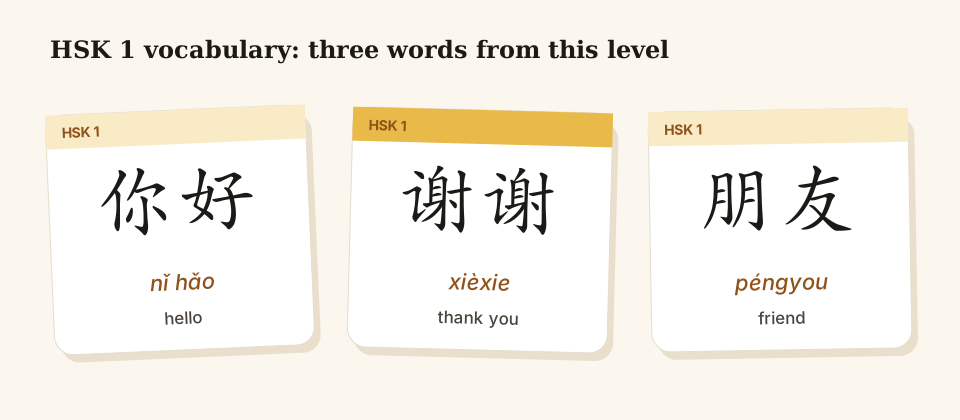
For a first lesson built on the new HSK, watch lesson 1 of my beginner course on my other YouTube channel, Chinese Step by Step:
The video loads from YouTube when you press play.
The HSK 1 exam format
Until the Dutch test centres switch to HSK 3.0 in December 2026, HSK 1 uses the familiar format:
| Part | Questions | Time | What you do |
|---|---|---|---|
| Listening | 20 | about 15 min | Match short recordings to pictures, true/false with pictures, choose the answer to a question. Each recording plays twice. |
| Reading | 20 | about 17 min | Match words and sentences to pictures, choose the right word, match questions and answers. Pinyin is shown above the characters. |
In the internet-based test in Amsterdam you answer on a computer; on paper you fill in an answer sheet with a 2B pencil. HSK 1 is taken without the HSKK speaking test. All practical details, dates and fees are in the HSK exam guide for the Netherlands.
Sample HSK 1 questions
Listening, part 1 (true or false). You see a picture of a cup of tea and hear: 我想喝茶。Wǒ xiǎng hē chá. Does the picture match? Answer: yes (✓).
Listening, part 3. You hear: 你今天几点起床?Nǐ jīntiān jǐ diǎn qǐchuáng? and choose the matching answer: A 七点 qī diǎn · B 星期一 xīngqīyī · C 在家 zài jiā. Answer: A, seven o’clock.
Reading, part 3 (match question and answer). 你女儿几岁了? Nǐ nǚ’ér jǐ suì le? (How old is your daughter?) A 她五岁了。 · B 她在学校。 · C 她很高兴。 Answer: A.
Reading, part 4 (fill the gap). 我 ___ 中国人,我是荷兰人。 A 是 · B 不是 · C 没有. Answer: B, “I am not Chinese, I am Dutch.”
HSK 1 grammar points
The grammar of HSK 1 is limited and very regular. These are the patterns to master:
- 是 shì, “to be”, linking two nouns: 我是老师。Wǒ shì lǎoshī. Not used with adjectives.
- 很 hěn + adjective: 我很忙。Wǒ hěn máng. “I am busy.” No 是 here.
- Questions with 吗 ma: add 吗 to a statement: 你是学生吗?Nǐ shì xuésheng ma?
- Question words stay where the answer goes: 什么 (what), 谁 (who), 哪儿 (where), 几 (how many, under ten), 多少 (how many, how much), 怎么 (how), 怎么样 (how about).
- 的 de for possession: 我的书wǒ de shū “my book”; with family often dropped: 我妈妈.
- Negation with 不 bù and 没 méi: 不 for habits and the future, 没 for “did not” and with 有: 我没有车。Wǒ méiyǒu chē.
- Numbers and measure words: 三个人sān ge rén, 一本书yì běn shū, 五块钱wǔ kuài qián. Use 两 liǎng, not 二, before a measure word.
- 在 zài for location: 我在家。Wǒ zài jiā. and before a verb: 我在学校学习.
- Time before the verb: 我明天去北京。Wǒ míngtiān qù Běijīng. Time, then place, then action.
- Modal verbs 想, 会, 能: want to, can (learned skill), can (be able/allowed).
- 呢 ne for “and you?”: 我很好,你呢?Wǒ hěn hǎo, nǐ ne?
- 太…了 tài…le: 太贵了!Tài guì le! “Too expensive!”
- 都 dōu and 也 yě before the verb: 我们都是学生. 我也去.
- 了 le for a completed action (first introduction): 我买了一本书.
For a broader explanation of how Chinese sentences work, see Chinese grammar basics.
The complete HSK 1 vocabulary list
This is the full HSK 1 vocabulary list of the new HSK 3.0 syllabus. Use the filter to search, click any word to hear it, or download the list to make your own flashcards.
294 new words at HSK 1 · Click a word to hear it. · Download the HSK 1 word list (CSV, opens in Excel or Numbers)
| Word | Pinyin | Meaning |
|---|---|---|
| 爱 | ài | to love; to like |
| 八 | bā | eight |
| 吧 | ba | (suggestion particle) let's… |
| 爸爸 | bàba | dad, father |
| 百 | bǎi | hundred |
| 白天 | báitiān | daytime |
| 半 | bàn | half |
| 包子 | bāozi | steamed stuffed bun |
| 杯子 | bēizi | cup, glass |
| 本 | běn | (measure word for books) |
| 边 | biān | side |
| 病 | bìng | illness; ill |
| 不 | bù | not, no |
| 不客气 | bú kèqi | you're welcome |
| 不要 | búyào | don't |
| 菜 | cài | dish; vegetable |
| 茶 | chá | tea |
| 唱 | chàng | to sing |
| 超市 | chāoshì | supermarket |
| 车 | chē | car, vehicle |
| 吃 | chī | to eat |
| 穿 | chuān | to wear, to put on |
| 出租车 | chūzūchē | taxi |
| 大 | dà | big, large |
| 打电话 | dǎ diànhuà | to make a phone call |
| 大家 | dàjiā | everyone |
| 到 | dào | to arrive; to, until |
| 大学 | dàxué | university |
| 大学生 | dàxuéshēng | university student |
| 的 | de | (possessive particle) 's |
| 第 | dì | (ordinal prefix) No. |
| 点 | diǎn | o'clock; point; a little |
| 店 | diàn | shop, store |
| 电话 | diànhuà | telephone |
| 电脑 | diànnǎo | computer |
| 电视 | diànshì | television |
| 电影 | diànyǐng | film, movie |
| 电影院 | diànyǐngyuàn | cinema |
| 弟弟 | dìdi | younger brother |
| 东西 | dōngxi | thing, stuff |
| 都 | dōu | all, both |
| 读 | dú | to read (aloud); to study |
| 对 | duì | correct; towards |
| 对不起 | duìbuqǐ | sorry |
| 多 | duō | many, much |
| 多少 | duōshao | how many, how much |
| 读书 | dú shū | to read; to study |
| 二 | èr | two |
| 儿子 | érzi | son |
| 饭 | fàn | meal; cooked rice |
| 饭店 | fàndiàn | restaurant; hotel |
| 房间 | fángjiān | room |
| 非常 | fēicháng | very, extremely |
| 飞机 | fēijī | aeroplane |
| 分 | fēn | minute; to divide; cent |
| 分钟 | fēnzhōng | minute |
| 高兴 | gāoxìng | happy, glad |
| 歌 | gē | song |
| 个 | gè | (general measure word) |
| 哥哥 | gēge | older brother |
| 给 | gěi | to give; for |
| 公司 | gōngsī | company |
| 工作 | gōngzuò | to work; job |
| 狗 | gǒu | dog |
| 贵 | guì | expensive |
| 国 | guó | country |
| 还 | hái | still; also |
| 孩子 | háizi | child |
| 汉语 | Hànyǔ | Chinese (language) |
| 汉字 | Hànzì | Chinese character |
| 好 | hǎo | good; well |
| 号 | hào | date (day of month); number |
| 好吃 | hǎochī | tasty, delicious |
| 好看 | hǎokàn | good-looking; interesting |
| 好听 | hǎotīng | nice to hear |
| 好玩儿 | hǎowánr | fun |
| 喝 | hē | to drink |
| 和 | hé | and; with |
| 很 | hěn | very |
| 后 | hòu | after; behind |
| 回 | huí | to return |
| 会 | huì | can (learned skill); will |
| 火车 | huǒchē | train |
| 几 | jǐ | how many; a few |
| 家 | jiā | home, family |
| 见 | jiàn | to see; to meet |
| 件 | jiàn | (measure word for clothes, matters) |
| 叫 | jiào | to be called; to call |
| 饺子 | jiǎozi | dumpling |
| 家人 | jiārén | family member |
| 鸡蛋 | jīdàn | egg |
| 姐姐 | jiějie | older sister |
| 今年 | jīnnián | this year |
| 今天 | jīntiān | today |
| 九 | jiǔ | nine |
| 觉得 | juéde | to feel, to think |
| 开 | kāi | to open; to drive |
| 开车 | kāi chē | to drive a car |
| 看 | kàn | to look, to watch, to read |
| 看病 | kàn bìng | to see a doctor |
| 看见 | kànjiàn | to see |
| 课 | kè | lesson, class |
| 可以 | kěyǐ | can, may |
| 口 | kǒu | mouth |
| 块 | kuài | piece; yuan (money) |
| 来 | lái | to come |
| 老师 | lǎoshī | teacher |
| 了 | le | (particle: completed action, change) |
| 冷 | lěng | cold |
| 里 | lǐ | inside |
| 两 | liǎng | two (of something) |
| 零 | líng | zero |
| 六 | liù | six |
| 吗 | ma | (yes/no question particle) |
| 买 | mǎi | to buy |
| 卖 | mài | to sell |
| 妈妈 | māma | mum, mother |
| 忙 | máng | busy |
| 猫 | māo | cat |
| 没关系 | méi guānxi | it doesn't matter |
| 妹妹 | mèimei | younger sister |
| 没有 | méiyǒu | not have; did not |
| 们 | men | (plural for people) |
| 面包 | miànbāo | bread |
| 面条儿 | miàntiáor | noodles |
| 米饭 | mǐfàn | cooked rice |
| 明年 | míngnián | next year |
| 明天 | míngtiān | tomorrow |
| 名字 | míngzi | name |
| 哪 | nǎ | which |
| 那 | nà | that |
| 那边 | nàbiān | over there |
| 哪里 | nǎlǐ | where |
| 那里 | nàlǐ | there |
| 男 | nán | male |
| 男朋友 | nánpéngyou | boyfriend |
| 哪儿 | nǎr | where |
| 那儿 | nàr | there |
| 哪些 | nǎxiē | which ones |
| 那些 | nàxiē | those |
| 呢 | ne | (particle) and…?; ongoing |
| 能 | néng | can, to be able |
| 你 | nǐ | you |
| 年 | nián | year |
| 你们 | nǐmen | you (plural) |
| 您 | nín | you (polite) |
| 牛奶 | niúnǎi | milk |
| 女 | nǚ | female |
| 女儿 | nǚ'ér | daughter |
| 女朋友 | nǚpéngyou | girlfriend |
| 女士 | nǚshì | lady, Ms |
| 朋友 | péngyou | friend |
| 便宜 | piányi | cheap |
| 漂亮 | piàoliang | pretty, beautiful |
| 苹果 | píngguǒ | apple |
| 七 | qī | seven |
| 千 | qiān | thousand |
| 前 | qián | front; before |
| 钱 | qián | money |
| 起床 | qǐ chuáng | to get up |
| 请 | qǐng | please; to invite |
| 请问 | qǐngwèn | excuse me, may I ask |
| 去 | qù | to go |
| 去年 | qùnián | last year |
| 热 | rè | hot |
| 人 | rén | person |
| 认识 | rènshi | to know (a person) |
| 日 | rì | day; sun |
| 三 | sān | three |
| 上 | shàng | up, on; last, previous |
| 上班 | shàng bān | to go to work |
| 商店 | shāngdiàn | shop |
| 上课 | shàng kè | to attend class |
| 上午 | shàngwǔ | morning |
| 上学 | shàng xué | to go to school |
| 少 | shǎo | few, little |
| 谁 | shéi | who |
| 生病 | shēng bìng | to fall ill |
| 什么 | shénme | what |
| 十 | shí | ten |
| 事 | shì | matter, thing |
| 是 | shì | to be |
| 时候 | shíhou | time, moment |
| 时间 | shíjiān | time |
| 手机 | shǒujī | mobile phone |
| 书 | shū | book |
| 书店 | shūdiàn | bookshop |
| 水 | shuǐ | water |
| 睡 | shuì | to sleep |
| 水果 | shuǐguǒ | fruit |
| 睡觉 | shuì jiào | to sleep, go to bed |
| 说 | shuō | to say, to speak |
| 说话 | shuō huà | to talk |
| 四 | sì | four |
| 岁 | suì | years old |
| 他 | tā | he, him |
| 它 | tā | it |
| 她 | tā | she, her |
| 太 | tài | too; extremely |
| 他们 | tāmen | they (male/mixed) |
| 它们 | tāmen | they (things, animals) |
| 她们 | tāmen | they (female) |
| 天 | tiān | day; sky |
| 天气 | tiānqì | weather |
| 听 | tīng | to listen |
| 听见 | tīngjiàn | to hear |
| 同学 | tóngxué | classmate |
| 外 | wài | outside |
| 外边 | wàibian | outside |
| 玩 | wán | to play, have fun |
| 晚 | wǎn | late; evening |
| 晚饭 | wǎnfàn | dinner |
| 晚上 | wǎnshang | evening |
| 喂 | wéi | hello (on the phone) |
| 问 | wèn | to ask |
| 问题 | wèntí | question; problem |
| 我 | wǒ | I, me |
| 我们 | wǒmen | we, us |
| 五 | wǔ | five |
| 午饭 | wǔfàn | lunch |
| 下 | xià | down; below; next |
| 下班 | xià bān | to finish work |
| 下课 | xià kè | class is over |
| 想 | xiǎng | to want; to think; to miss |
| 先生 | xiānsheng | Mr; gentleman; husband |
| 现在 | xiànzài | now |
| 小 | xiǎo | small, little |
| 小朋友 | xiǎopéngyǒu | child (friendly) |
| 小时 | xiǎoshí | hour |
| 小学 | xiǎoxué | primary school |
| 小学生 | xiǎoxuéshēng | primary-school pupil |
| 下午 | xiàwǔ | afternoon |
| 下雨 | xià yǔ | to rain |
| 些 | xiē | some |
| 写 | xiě | to write |
| 谢谢 | xièxie | thank you |
| 喜欢 | xǐhuan | to like |
| 新 | xīn | new |
| 星期 | xīngqī | week |
| 星期日 | xīngqīrì | Sunday |
| 星期天 | xīngqītiān | Sunday |
| 休息 | xiūxi | to rest |
| 学 | xué | to learn, to study |
| 雪 | xuě | snow |
| 学生 | xuésheng | student |
| 学习 | xuéxí | to study |
| 学校 | xuéxiào | school |
| 要 | yào | to want; will; need |
| 也 | yě | also, too |
| 一 | yī | one |
| 一半 | yíbàn | half |
| 一点儿 | yìdiǎnr | a little |
| 衣服 | yīfu | clothes |
| 医生 | yīshēng | doctor |
| 一些 | yìxiē | some |
| 医院 | yīyuàn | hospital |
| 椅子 | yǐzi | chair |
| 有 | yǒu | to have; there is |
| 有的 | yǒude | some |
| 有点儿 | yǒudiǎnr | a bit, slightly |
| 有些 | yǒuxiē | some; somewhat |
| 雨 | yǔ | rain |
| 元 | yuán | yuan (currency) |
| 月 | yuè | month; moon |
| 再 | zài | again |
| 在 | zài | at, in; to be (at) |
| 再见 | zàijiàn | goodbye |
| 早 | zǎo | early; good morning |
| 早饭 | zǎofàn | breakfast |
| 早上 | zǎoshang | morning |
| 怎么 | zěnme | how; why |
| 怎么样 | zěnmeyàng | how about; how is it |
| 找 | zhǎo | to look for |
| 这 | zhè | this |
| 这边 | zhèbiān | this side, here |
| 这里 | zhèlǐ | here |
| 真 | zhēn | really, truly |
| 正在 | zhèngzài | in the middle of (doing) |
| 这儿 | zhèr | here |
| 这些 | zhèxiē | these |
| 只 | zhǐ | only |
| 知道 | zhīdào | to know |
| 中国 | Zhōngguó | China |
| 中文 | Zhōngwén | Chinese (language) |
| 中午 | zhōngwǔ | noon |
| 中学 | zhōngxué | secondary school |
| 中学生 | zhōngxuéshēng | secondary-school pupil |
| 住 | zhù | to live (somewhere) |
| 桌子 | zhuōzi | table |
| 字 | zì | character, word |
| 坐 | zuò | to sit; to travel by |
| 做 | zuò | to do, to make |
| 做饭 | zuò fàn | to cook |
| 昨天 | zuótiān | yesterday |
Is the HSK 1 test hard?
Honestly: no. HSK 1 is the friendliest exam in the series. The listening is slow and clear, many reading questions show pinyin, and you pass with 60 percent. What makes candidates fail is rarely the Chinese; it is unfamiliarity with the format (matching pictures quickly, the speed of the recordings) and tones that were never quite learned, which makes listening harder. A couple of practice tests under real timing solve the first problem; a teacher solves the second.
The video loads from YouTube when you press play.
How long does it take to prepare for HSK 1?
For a complete beginner, plan 80–120 hours in total: about 30–40 lesson hours with a teacher and the rest in short daily practice. With two lessons a week that is two to four months. If you already speak a little Chinese, the intake shows what is missing and preparation can take a few weeks. For the full picture across all levels, read how long it takes to learn Chinese.
After HSK 1
The natural next step is HSK 2: about 200 new words, your first complements and comparisons, and conversations about plans and experiences. If you want structured help on the way, my HSK preparation course and course for beginners cover HSK 1 from the very first lesson.
Word list: the official HSK 3.0 vocabulary (2025 syllabus), as compiled in the open complete-hsk-vocabulary project (MIT licence). Pinyin checked and meanings written by KeSong Chinese.
Frequently asked questions
Is the HSK 1 test hard?
No, HSK 1 is designed as a first milestone. In the current format it has only listening and reading, with pictures and pinyin to help, and you pass with 120 out of 200 points. Most adults who study regularly with a teacher pass it after two to four months. The new HSK 3.0 HSK 1 has about 300 words, so it asks a little more than before.
How long does it take to prepare for HSK 1?
For a complete beginner, about 80–120 hours in total, including 30–40 lesson hours with a teacher. With two lessons a week and 15–20 minutes of daily practice, that is two to four months. Learners who already know some Chinese can be ready in a few weeks.
How many words do I need for HSK 1?
Under the new HSK 3.0 syllabus, HSK 1 has about 300 words (294 in the official list used here). The old HSK 2.0 had 150. If your exam still uses the old format, the new list covers everything and more, so you lose nothing by learning it.
Do I need to write characters for HSK 1?
In the current exam format you do not write anything at HSK 1: you only listen and read, and many questions show pinyin. The HSK 3.0 syllabus does list characters you should recognise at this level, so learning to read the most common characters is still wise.
What is the HSK 1 pass mark?
In the HSK 2.0 format, HSK 1 has two parts, listening and reading, each worth 100 points. The total is 200 points and you pass with 120. There is no minimum per part. Check the scoring rules of the HSK 3.0 syllabus if your exam is from December 2026 onwards.
Prepare for HSK 1 with Zoey
One-to-one or small-group HSK 1 preparation, online or in Amsterdam, from pinyin to exam day.
Keep reading
-
HSK 2
Word list, grammar, exam format and sample questions.
-
HSK preparation
Targeted preparation for HSK 1–6 and HSKK, including the new HSK 3.0.
-
HSK exam guide
Levels, HSK 3.0, test centres, dates, fees and registration in the Netherlands.
-
Beginners
Start from zero: pinyin, tones, your first characters and real conversations.
About the author
Zoey (Ziqiao Zang, 臧子乔) has taught Chinese as a foreign language since 2011 and in the Netherlands since 2016. She holds a Master of Teaching Chinese to Speakers of Other Languages from Zhejiang Normal University and set up and ran an official HSK online exam centre with more than 250 candidates.