Chinese culture: what learners should know
Chinese culture is more than dragons and dumplings. Behind the language sit a few values that explain a lot of everyday behaviour: face, relationships, harmony, respect for family and for learning. Here I explain them as a Chinese person living in the Netherlands, together with the habits, festivals and arts you will meet, and where to find Chinese culture in Amsterdam.
 By Zoey (Ziqiao Zang), Chinese teacher since 2011
When students ask why Chinese people do something, the answer is often one of a handful of values. Knowing them won’t explain every person (China is huge and very diverse), but it helps you understand what is said, and what isn’t.
Core values in Chinese culture
| ▶ | Value | Pinyin | Meaning | What you notice |
|---|---|---|---|---|
| 面子 | miànzi | face: reputation and dignity | Praise in public, criticism in private; compliments are politely denied | |
| 关系 | guānxi | relationships and trust networks | People help friends of friends; business starts with meals and small talk | |
| 和 | hé | harmony | Open conflict is avoided; "maybe" or "we'll see" can mean no | |
| 孝 | xiào | respect for parents and elders | Adult children support parents; elders are served first at the table | |
| 客气 | kèqi | politeness, modesty | Refusing a gift or a second helping once or twice before accepting | |
| 学习 | xuéxí | learning and effort | Education is a family project; effort counts more than talent |
Face, in practice
When you compliment a Chinese person on their English, they will probably say 哪里哪里nǎli nǎli (“where, where?”), meaning “not at all”. Accepting praise too directly can feel boastful. In the same way, a manager who corrects someone in front of the team makes both of them lose face; a quiet word later works much better. My article on Chinese business etiquette applies this to meetings and dinners.
Saying no without saying no
Because harmony matters, a direct “no” is rare. You hear 我考虑一下wǒ kǎolǜ yíxià (I’ll think about it), 可能不太方便kěnéng bú tài fāngbiàn (it may not be very convenient) or a change of subject. For Dutch people, famous for directness, this is often the biggest cultural difference.
Chinese culture in everyday life
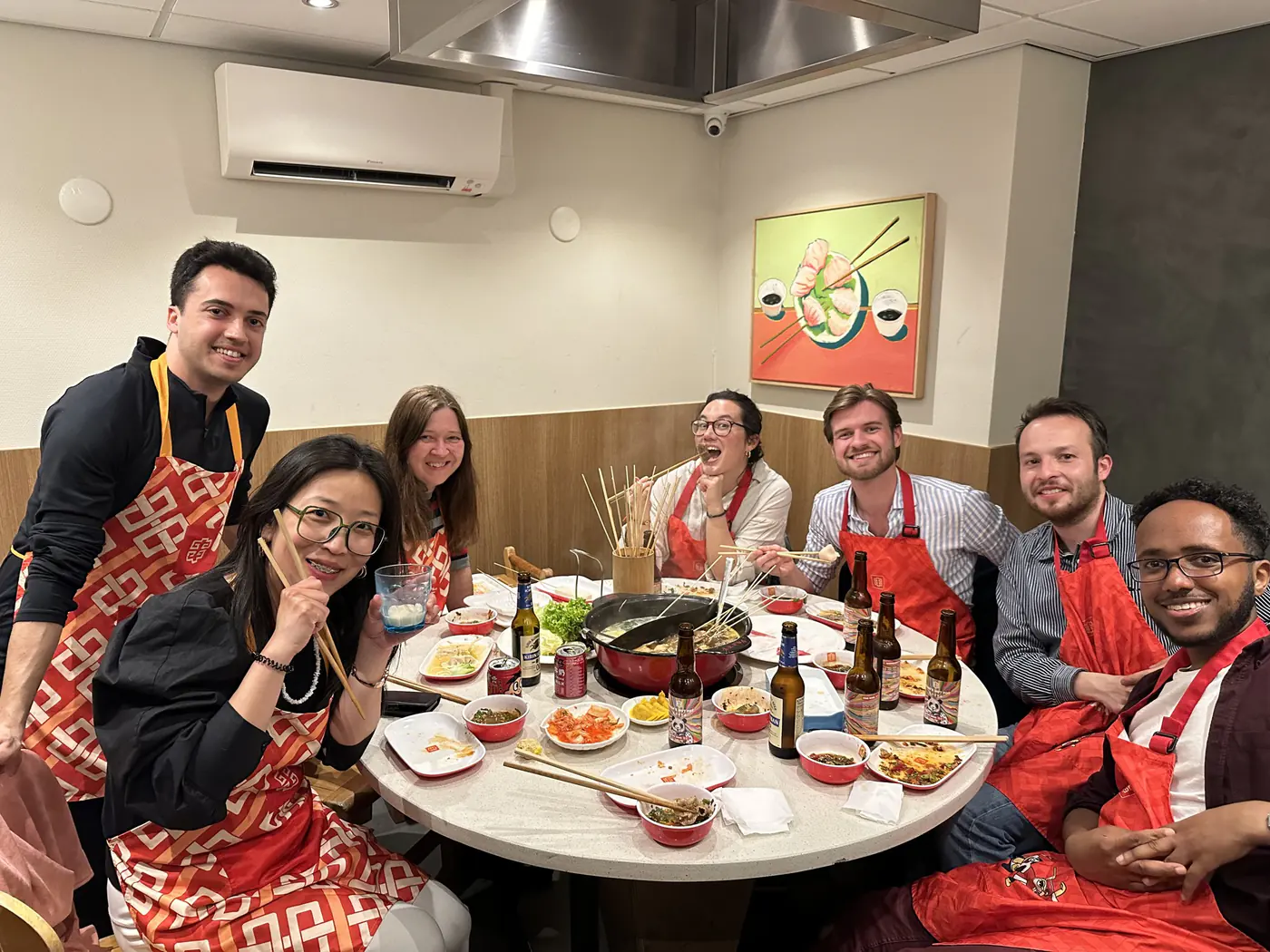
- Meals are shared. Dishes go in the middle and everyone takes from them; the host orders, and often orders too much, because an empty table means the guests were not looked after.
- Fighting over the bill is a ritual of generosity, not a misunderstanding. Splitting the bill (AA制) is common among young people and colleagues, but between friends someone usually insists on paying, and next time it’s the other’s turn.
- Hot water is drunk all year round, and 多喝热水 (“drink more hot water”) is the standard advice for almost any illness.
- Greetings are practical: 吃了吗?Chī le ma? (“Have you eaten?”) is a traditional greeting, not an invitation.
- Personal questions about age, salary, marriage or weight are often a sign of interest, not rudeness.
- Phones run everything: WeChat for messaging, payments and work; cash is rare in cities.
- Parks are social spaces: tai chi in the morning, and square dancing (广场舞) in the evening.
The video loads from YouTube when you press play.
Festivals and celebrations in China
| ▶ | Festival | Pinyin | When | Traditions |
|---|---|---|---|---|
| 春节 | Chūnjié | January/February | Spring Festival: family dinner, red envelopes, fireworks | |
| 元宵节 | Yuánxiāojié | 15 days later | Lantern Festival: lanterns, riddles, sweet rice balls | |
| 清明节 | Qīngmíngjié | early April | Tomb-sweeping: honouring ancestors, spring outings | |
| 端午节 | Duānwǔjié | May/June | Dragon Boat Festival: boat races, zongzi | |
| 中秋节 | Zhōngqiūjié | September/October | Mid-Autumn: moon-watching, mooncakes, family | |
| 国庆节 | Guóqìngjié | 1 October | National Day: a week-long holiday |
The lunar festivals move each year in the Western calendar. The next Spring Festival falls on 6 February 2027: see Chinese New Year and find your animal with the Chinese zodiac calculator.
Art and culture of China
China’s arts are a lovely way into the language, because so many are built on characters:
- Calligraphy (书法 shūfǎ): writing characters with a brush is an art and a meditation.
- Tea (茶 chá): from green Longjing to dark Pu’er, with its own etiquette of pouring for others first.
- Paper cutting (剪纸 jiǎnzhǐ): red window decorations, often with 福 (fortune) for the New Year.
- Chinese opera, tai chi and poetry: Tang-dynasty poems are still learned by heart and quoted in daily life.
Ancient China’s civilisation (with inventions like paper, printing, the compass and gunpowder) still shapes how people talk: thousands of four-character idioms (成语) come from old stories. In my Chinese culture workshops you try calligraphy, tea and seasonal traditions yourself, with the Chinese words that go with them.
Culture shock in China, and in the Netherlands
Chinese culture in Amsterdam
The Netherlands has a long Chinese history: Chinese seamen in Rotterdam and Amsterdam from the early twentieth century, Chinese-Indonesian families after Indonesian independence, restaurant owners from Hong Kong and southern China from the 1950s, and today students, professionals and families from all over China.
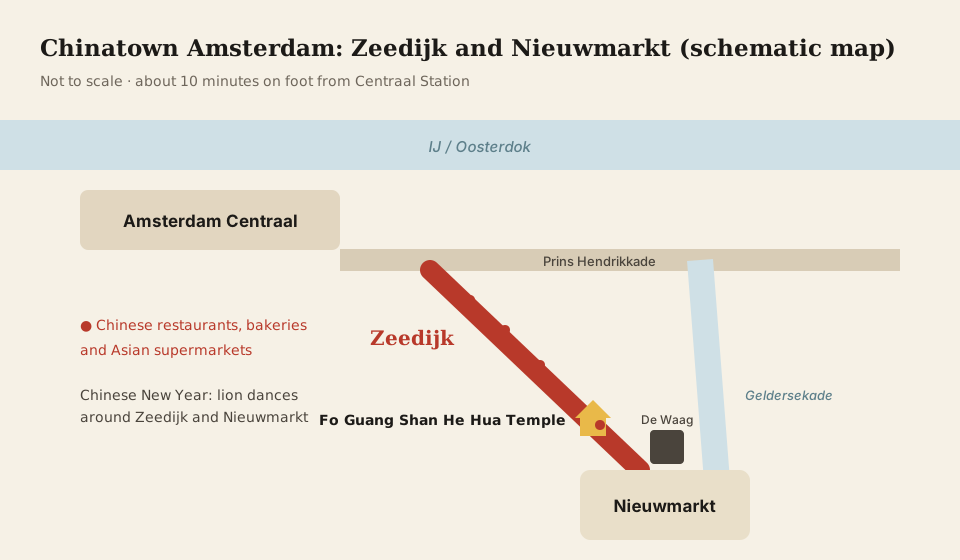
Chinatown Amsterdam lies on and around the Zeedijk and the Nieuwmarkt, a short walk from Centraal Station, with restaurants, bakeries, Asian supermarkets and the Fo Guang Shan He Hua Temple. It is where lion dances fill the streets at Chinese New Year. For more places, from libraries to language exchanges, read learning Chinese in Amsterdam.
The best way into a culture is through its language. When you understand why someone says 哪里哪里 or 吃了吗, you are not just speaking Chinese; you are thinking a little bit in Chinese.
Frequently asked questions
What are the main values in Chinese culture?
Important values are face (面子, social reputation), relationships (关系, guanxi), harmony (和) and avoiding open conflict, respect for parents and elders (孝), and a high value placed on education and effort. They show up in how people give compliments, refuse requests, share meals and look after family.
What are the most important Chinese festivals?
The Spring Festival (Chinese New Year) is the biggest, followed by the Lantern Festival two weeks later. Other major festivals are Qingming (tomb-sweeping, in April), the Dragon Boat Festival (in early summer) and the Mid-Autumn Festival with mooncakes. National Day on 1 October starts a week-long holiday.
Where is Chinatown in Amsterdam?
Amsterdam's Chinatown is on and around the Zeedijk and the Nieuwmarkt, about ten minutes' walk from Centraal Station. It has Chinese restaurants, bakeries, Asian supermarkets and the Fo Guang Shan He Hua Temple, and it is the centre of Chinese New Year celebrations in the city.
What causes culture shock in China?
Visitors are often surprised by the directness about age, salary or weight, the crowds and noise, the habit of drinking hot water, fights over who pays the bill, and the indirectness when someone means no. Most of it makes sense once you know the values behind it.
Learn with Zoey
One-to-one or in a small group, online or in Amsterdam by arrangement. Tell Zoey what you want to achieve and she will suggest a plan.
Keep reading
-
Culture workshops
Calligraphy, Chinese New Year and paper-cutting workshops for teams and organisations.
-
Chinese New Year 2027
The date, the Year of the Goat, traditions, wishes and Amsterdam celebrations.
-
Chinese business etiquette
Business cards, meetings, dinners, toasts and guanxi, explained by a teacher.
-
Basic Chinese phrases
Hello, thank you, sorry, I love you: with characters, pinyin and audio.
About the author
Zoey (Ziqiao Zang, 臧子乔) has taught Chinese as a foreign language since 2011 and in the Netherlands since 2016. She holds a Master of Teaching Chinese to Speakers of Other Languages from Zhejiang Normal University and set up and ran an official HSK online exam centre with more than 250 candidates.