Chinese New Year 2027: the Year of the Goat begins on 6 February
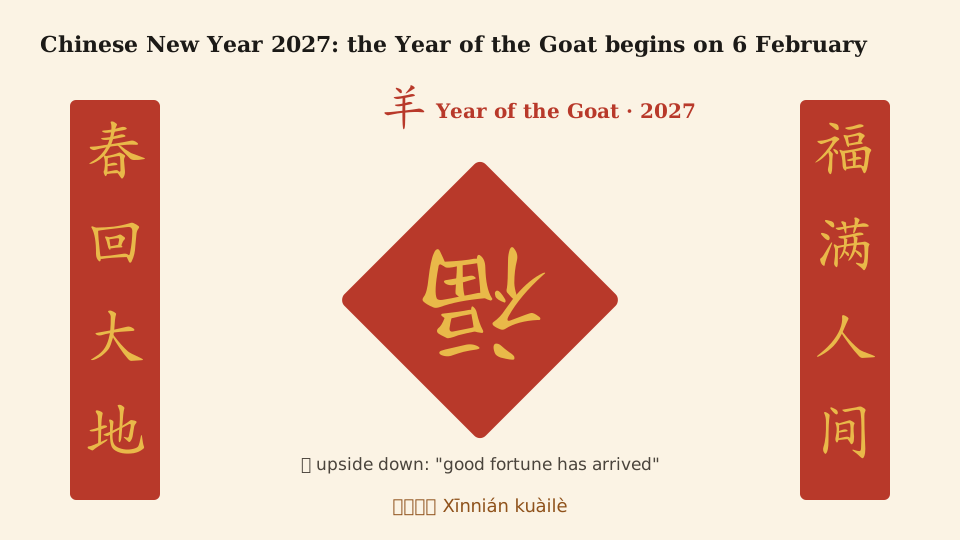
Chinese New Year 2027 falls on Saturday 6 February 2027, with New Year's Eve on Friday 5 February. It opens the Year of the Goat (羊年), more precisely the Fire Goat, which lasts until 25 January 2028. Here is everything you need: the dates for the coming years, the traditions, the wishes with pronunciation, the don'ts, and where to celebrate in Amsterdam.
 By Zoey (Ziqiao Zang), Chinese teacher since 2011
When is Chinese New Year?
Chinese New Year (春节 Chūnjié, “Spring Festival”, also called Lunar New Year) follows the traditional Chinese lunisolar calendar. It falls on the second new moon after the winter solstice, which is always between 21 January and 20 February. That is why the date moves every year.
| Year | Chinese New Year | Animal | Element |
|---|---|---|---|
| 2026 | Tuesday 17 February | Horse 马 | Fire |
| 2027 | Saturday 6 February | Goat 羊 | Fire |
| 2028 | Wednesday 26 January | Monkey 猴 | Earth |
| 2029 | Tuesday 13 February | Rooster 鸡 | Earth |
| 2030 | Sunday 3 February | Dog 狗 | Metal |
So when is Chinese New Year 2027? On 6 February, with the reunion dinner on New Year’s Eve, Friday 5 February. The festive period traditionally lasts fifteen days, until the Lantern Festival (元宵节) on 20 February 2027.
2027: the Year of the Goat
The Year of the Goat 2027 begins on 6 February 2027 and runs until 25 January 2028. The Chinese character 羊yáng covers goat, sheep and ram, so you will see all three translations. People born in a Goat year (1955, 1967, 1979, 1991, 2003, 2015, 2027) are said to be gentle, creative and kind-hearted. In the sixty-year cycle, 2027 is a Fire Goat year (丁未). Find your own animal with the Chinese zodiac calculator.
How Chinese New Year is celebrated
New Year’s Eve: the reunion dinner
The most important moment is New Year’s Eve (除夕 chúxī), when families gather for the reunion dinner (年夜饭 niányèfàn). Hundreds of millions of people travel home for it, the largest annual migration on earth (春运 chūnyùn). Dishes carry wishes through their names:
- Fish (鱼 yú) sounds like 余, “surplus”: 年年有余niánnián yǒu yú, “abundance every year”.
- Dumplings (饺子 jiǎozi), especially in the north, shaped like old silver ingots.
- Rice cake (年糕 niángāo) sounds like “higher every year”.
- Long noodles for long life.
After dinner many families watch the CCTV Spring Festival Gala (春晚) and stay up to welcome the new year.
Red envelopes
Older relatives give red envelopes (红包 hóngbāo) with money to children and unmarried younger family members. The amount avoids the number 4; amounts with 8 or 6 are popular. Today many red envelopes are sent digitally via WeChat. Learn why numbers matter in Chinese numbers.
Couplets and 福 upside down
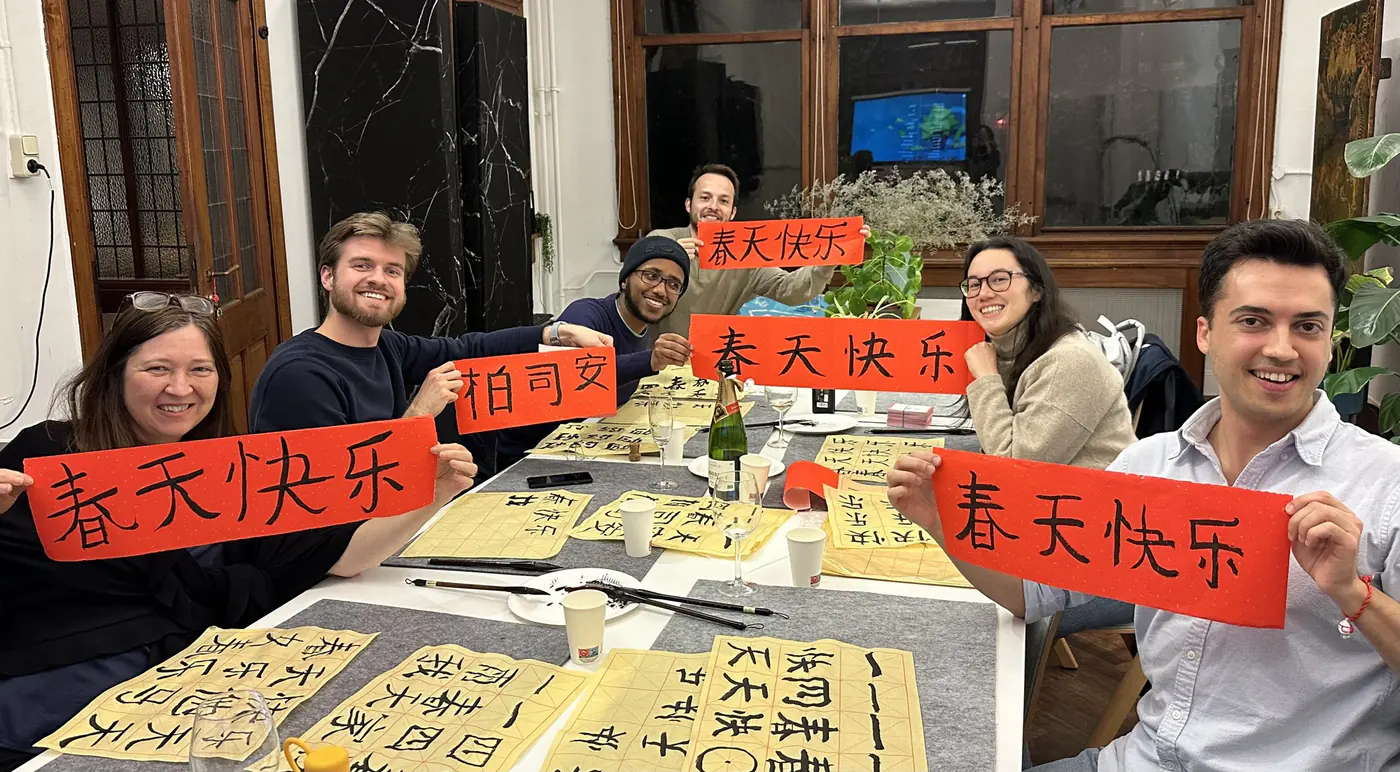
Front doors are decorated with red couplets (春联 chūnlián), two vertical lines of poetry, and the character 福 (good fortune) is hung upside down. Why? “Upside down” is 倒 (dào), which sounds like 到 (dào), “to arrive”: an upside-down 福 says “good fortune has arrived”.
Firecrackers and the monster Nian
Legend tells of a monster, Nian (年), that came every New Year to terrorise villages and was frightened away by the colour red and loud noise. Hence red decorations and firecrackers, though many Chinese cities now restrict fireworks.
Visiting and wishing: 拜年
In the first days of the new year people visit relatives and friends to 拜年 (bàinián), offer New Year wishes and bring gifts such as fruit, tea or sweets.
What not to do on Chinese New Year
Some traditional don’ts, observed more or less strictly depending on the family:
- Don’t sweep or take out the rubbish on New Year’s Day: you would sweep away the good luck.
- Don’t break things, and avoid knives and scissors, which symbolise cutting off fortune. If a dish breaks, people say 岁岁平安suìsuì píng'ān: “peace year after year” (碎 “broken” sounds like 岁 “year”).
- Don’t say unlucky words such as death, illness or poverty, and avoid the number four.
- Don’t wash your hair on the first day: 发 (hair) sounds like 发 in 发财 (prosperity).
- Don’t lend or borrow money, or you will be doing it all year.
Chinese New Year wishes, with pronunciation
| ▶ | Chinese | Pinyin | English | When to use it |
|---|---|---|---|---|
| 新年快乐 | xīnnián kuàilè | Happy New Year | To everyone | |
| 春节快乐 | Chūnjié kuàilè | Happy Spring Festival | Specifically Chinese New Year | |
| 恭喜发财 | gōngxǐ fācái | Wishing you prosperity | The classic, also to colleagues | |
| 万事如意 | wànshì rúyì | May everything go as you wish | Cards and toasts | |
| 身体健康 | shēntǐ jiànkāng | Good health | Especially to older people | |
| 羊年大吉 | yángnián dàjí | Great luck in the Year of the Goat | Specific to 2027 | |
| 年年有余 | niánnián yǒu yú | Abundance every year | Often written on decorations | |
| 恭喜恭喜 | gōngxǐ gōngxǐ | Congratulations! | Cheerful greeting during the festival |
These are the Chinese New Year wishes you will hear most. For more everyday phrases, see basic Chinese phrases.
Chinese New Year in Amsterdam
Chinese New Year in Amsterdam is celebrated every year in and around Chinatown, on the Zeedijk and the Nieuwmarkt. The celebrations traditionally centre on the Fo Guang Shan He Hua Temple on the Zeedijk, with lion dances moving from shop to shop, firecrackers and stalls; in recent years there have also been dragon dances on Dam Square and programmes at the Wereldmuseum Amsterdam (in 2026 a weekend of workshops and performances around the Year of the Horse). The exact 2027 programme is usually announced in January; check the city’s event calendar and the temple’s own announcements.
Tips for the day:
- Go early in the afternoon; the Zeedijk gets very busy.
- Bring cash for the food stalls and Chinese bakeries.
- Visit the temple respectfully: quiet voices, no photos where signs ask you not to.
- Order in Chinese in a Chinatown restaurant, and wish the staff 新年快乐xīnnián kuàilè.
More about the neighbourhood in where to learn Chinese in Amsterdam.
The video loads from YouTube when you press play.
Celebrate with a workshop
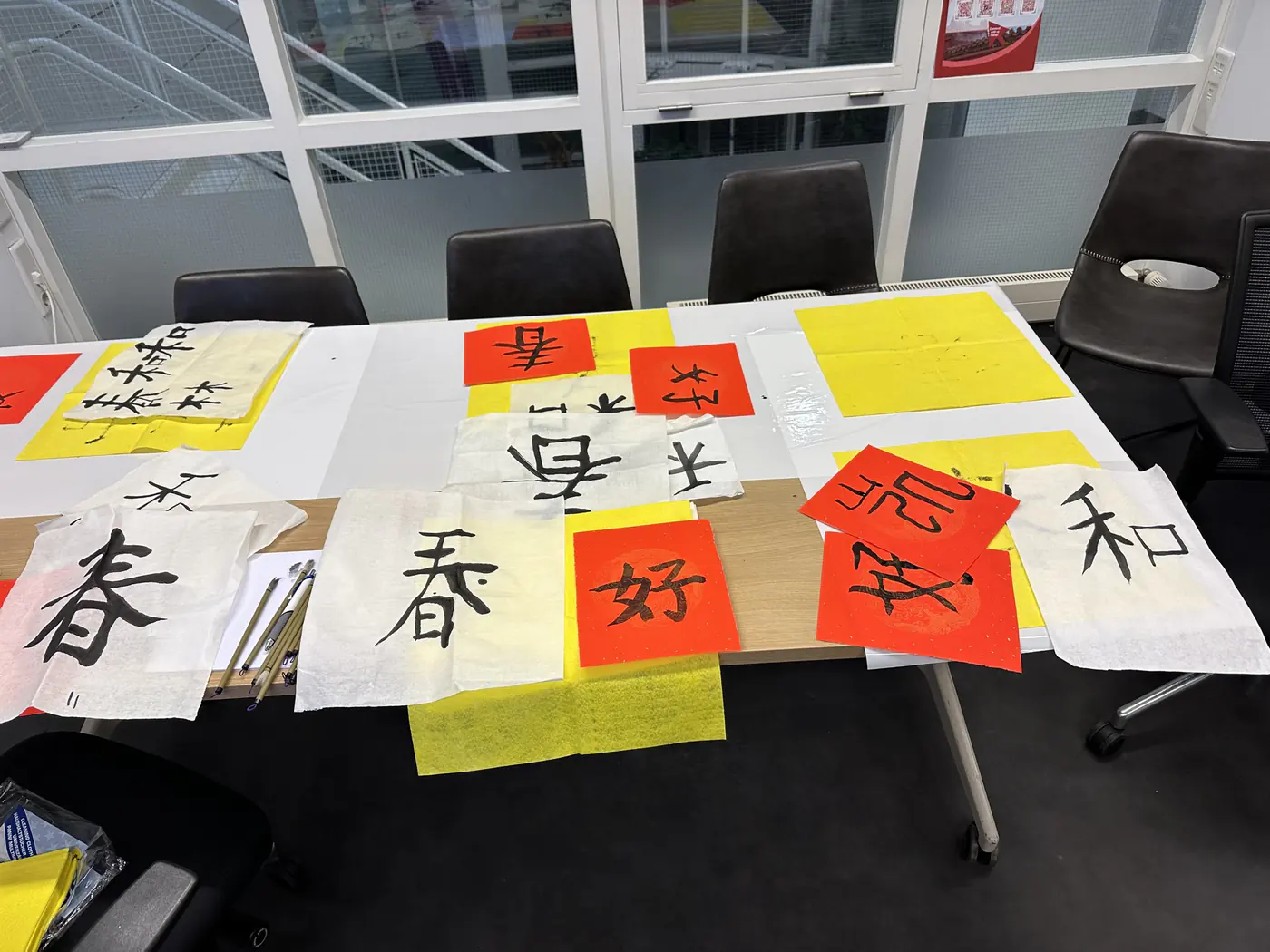
Chinese New Year is the perfect moment for a Chinese New Year workshop at work, in a library or at an event: participants write 福 with a brush, learn the wishes and hear the stories behind the customs. Read more about the culture workshops, and book early: the weeks around 6 February 2027 are always the busiest.
Frequently asked questions
When is Chinese New Year 2027?
Chinese New Year 2027 is on Saturday 6 February 2027. New Year's Eve, the most important family evening, is on Friday 5 February. The celebrations traditionally last fifteen days and end with the Lantern Festival on Saturday 20 February 2027.
What animal is the Chinese year 2027?
2027 is the Year of the Goat (羊 yáng, also translated as Sheep or Ram). Combined with the element, it is a Fire Goat year (丁未). It begins on 6 February 2027 and ends on 25 January 2028, so people born in January 2027 still belong to the Year of the Horse.
What are three don'ts on Chinese New Year's Day?
Traditionally: don't sweep or take out the rubbish, because you would sweep away good luck; don't break things or use knives and scissors, which symbolise cutting off fortune; and don't say unlucky words such as death or illness. Many families also avoid washing their hair and lending money on the first day.
What is the Chinese year 2028?
2028 is the Year of the Monkey (猴 hóu), an Earth Monkey year (戊申). Chinese New Year 2028 falls on Wednesday 26 January 2028, unusually early because the lunar calendar shifts the date every year.
Why does the date of Chinese New Year change every year?
Chinese New Year follows the traditional lunisolar calendar. It falls on the second new moon after the winter solstice, which always lands between 21 January and 20 February in the Western calendar. That is why it was 17 February in 2026 and is 6 February in 2027.
Book a Chinese New Year workshop
Calligraphy, couplets and New Year customs for your team, library or event, in Amsterdam or online. The weeks around 6 February fill up first.
Keep reading
-
Culture workshops
Calligraphy, Chinese New Year and paper-cutting workshops for teams and organisations.
-
Chinese zodiac calculator
Find your animal and element by birth date, with characters and pronunciation.
-
Basic Chinese phrases
Hello, thank you, sorry, I love you: with characters, pinyin and audio.
-
Chinese culture for learners
Values, everyday habits, festivals and Chinese culture in the Netherlands.
About the author
Zoey (Ziqiao Zang, 臧子乔) has taught Chinese as a foreign language since 2011 and in the Netherlands since 2016. She holds a Master of Teaching Chinese to Speakers of Other Languages from Zhejiang Normal University and set up and ran an official HSK online exam centre with more than 250 candidates.