Chinese conversation class, for learners who want to speak
A Chinese conversation class for adults who understand quite a lot but freeze when they have to speak. Real topics, lots of speaking time, corrections that stick, and morning slots for people who want to practise before work. Small groups or one-to-one, online or in Amsterdam.
 By Zoey (Ziqiao Zang), Chinese teacher since 2011
Many learners know this feeling. You have done the apps, you have a textbook full of notes, you can read quite a few characters and you understand when someone speaks slowly. And then a Chinese colleague asks you a simple question, and nothing comes out. That gap between understanding and speaking is normal, and it closes with one thing only: speaking. These conversational Chinese classes exist to give you that practice, with a teacher who keeps you talking and makes every correction count.
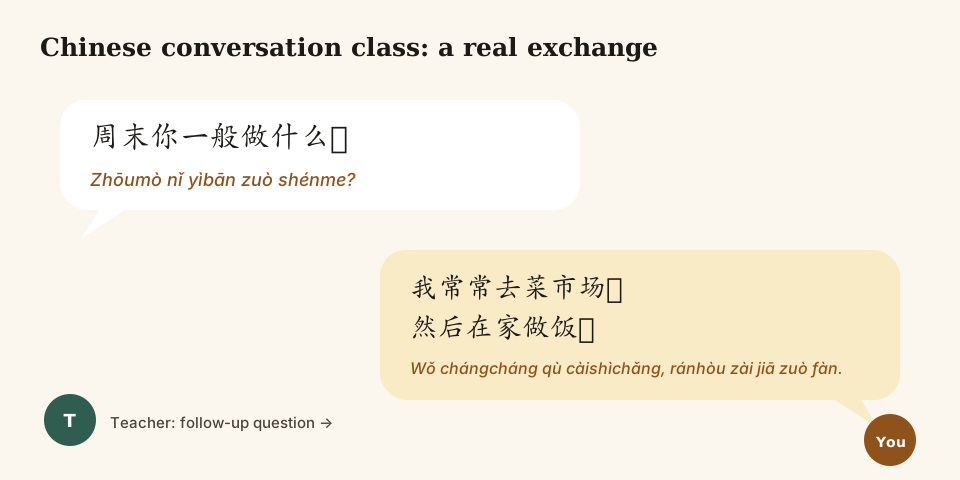
Who the conversation classes are for
- Learners from about HSK 2 upwards who understand more than they can say.
- Returners who learned Chinese at university or lived in China years ago and want to reactivate it.
- Learners who freeze when they have to speak, even though they know the words.
- Professionals who need to make small talk with Chinese partners and colleagues; see also Business Chinese.
- Learners with a Chinese partner or in-laws, who want to take part in the conversation at the dinner table.
What happens in a conversation class
Each class is built around one topic and three goals: say more, say it more naturally, and fix one recurring mistake.
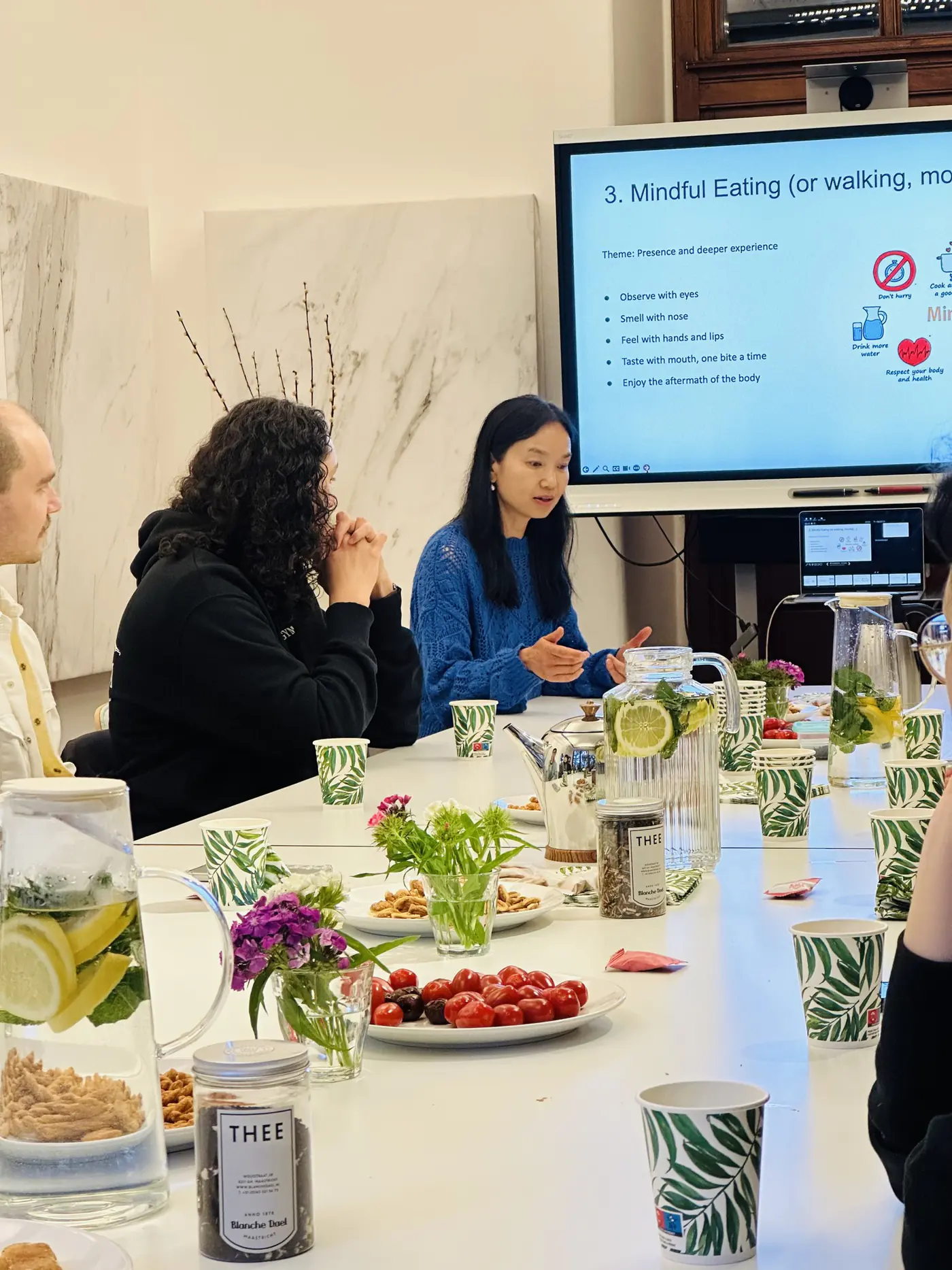
- Warm-up. Five minutes of easy chat to get your Chinese moving.
- Input. A short dialogue, story or video clip on the topic of the day, with the key phrases.
- Speaking tasks. Role plays, describing and comparing, telling a story, giving your opinion. You speak for most of the lesson.
- Feedback. Not every mistake is corrected in the moment, which would stop the flow, but the important ones are noted and practised at the end.
- Take-away. Five phrases to use in the coming days.
Topics
Topics follow your interests and your level. Typical examples:
| Everyday | Work | Culture and ideas |
|---|---|---|
| Weekends and holidays | Introducing your job and company | Chinese festivals and food |
| Food, cooking and restaurants | Meetings and phone calls | Films, books and series |
| Housing, the neighbourhood | Travel for work | Family and generations |
| Health and sport | WeChat messages and small talk | Life in the Netherlands and China |
Zoey’s own podcast-style videos are a good taste of the topics. In this one, about the simple WeChat message 在吗?zài ma?, you hear how much a two-character question can carry:
The video loads from YouTube when you press play.
Class size and format
Conversation classes run as small groups, so everyone speaks a lot, or one-to-one for maximum speaking time. Both are available online or in person in Amsterdam by arrangement. If you are looking for a Chinese conversation class in Amsterdam with a few other learners at your level, mention it in your enquiry and Zoey will tell you which groups are being formed. One-to-one lessons cost €60 per hour; group fees depend on the number of learners.
Morning classes: Chinese before work
Many learners find their energy for a language in the morning, before email takes over. Morning classes are planned early in the day, online or in person, so you start with half an hour or an hour of Chinese. Short, regular morning sessions work especially well for speaking: your brain is fresh and you carry the phrases with you into the day. Exact times are agreed after your enquiry.
How long does it take to learn conversational Chinese?
That depends on what you mean by “conversation”:
- Introducing yourself and simple exchanges: about 80–120 hours of study, roughly HSK 1.
- Everyday conversations about plans, experiences and opinions: about 160–240 hours, roughly HSK 2.
- Comfortable conversation on many topics: about 600–900 hours, around HSK 4.
Learners who practise speaking from the beginning get there faster, because they build the habit of producing Chinese, not only recognising it. For the full picture see how long it takes to learn Chinese.
How do I learn conversational Chinese? Five habits that work
- Learn phrases, not words. 我觉得…wǒ juéde… “I think…”, 你说得对。nǐ shuō de duì. “You’re right.” Chunks come out faster than single words.
- Prepare your top ten topics. Your job, your family, your weekend, your city: make sure you can talk about each for two minutes.
- Shadow native speakers. Play a short dialogue and speak along, matching the rhythm and tones.
- Keep talking. When you don’t know a word, describe it: 就是那个…jiù shì nàge… “you know, that thing…”. Native speakers do it too.
- Get feedback. Ten corrected minutes are worth more than an hour of unchecked chatting.
Extra practice outside class
- Meetups and language exchange. Amsterdam has a Chinese language and culture community on Meetup, and many universities run language-exchange evenings. They are a good, relaxed way to use what you learn.
- Language-exchange apps such as HelloTalk or Tandem connect you with Chinese speakers learning Dutch or English.
- Chinese culture in the city, from the Chinatown on and around Zeedijk to Chinese New Year at Nieuwmarkt. See where to learn Chinese in Amsterdam.
These are best combined with lessons: practice outside class shows you what you need, and the lessons fix it. If you also want to strengthen the basics, see basic Chinese phrases and Chinese culture for learners.
Book a conversation class
Send an enquiry with your level, your goals and the times you prefer, mornings included. Zoey will suggest one-to-one lessons or a suitable group, and a first topic to get you talking. This is Chinese speaking practice with a purpose: a Chinese speaking course built around your own topics, and a Mandarin conversation class you will actually look forward to.
Frequently asked questions
How long will it take to learn conversational Chinese?
Simple conversations about yourself, your work and daily plans are possible after about 160–240 hours of study, around HSK 2, which is six to nine months for most adults. Comfortable conversation on a wide range of topics takes about 600–900 hours, around HSK 4. Regular speaking practice from the start shortens the road considerably.
How do I learn conversational Chinese?
Speak from the first week, even if it is only a few sentences. Learn whole phrases rather than single words, practise the most frequent conversation topics until they feel automatic, and get regular feedback on your tones. Combine lessons with listening to natural dialogues, and use every chance to talk with Chinese speakers.
What level do I need for the conversation classes?
The classes work best from about HSK 2: you know the basics and a few hundred words, but speaking still feels hard. Complete beginners usually start with the beginners' course, where speaking is part of every lesson from day one, and move to conversation classes later.
When are the morning classes?
Morning slots are planned before the working day starts, and the exact times are agreed with Zoey after your enquiry. Online morning lessons are the easiest to fit in: no travel, just a headset and fifteen minutes to warm up your Chinese with a cup of tea.
Learn with Zoey
One-to-one or in a small group, online or in Amsterdam by arrangement. Tell Zoey what you want to achieve and she will suggest a plan.
Keep reading
-
Beginners
Start from zero: pinyin, tones, your first characters and real conversations.
-
How long does it take to learn Chinese?
Realistic hours per HSK level, what is hard, what is easy, and a 12-month plan.
-
Basic Chinese phrases
Hello, thank you, sorry, I love you: with characters, pinyin and audio.
-
Chinese culture for learners
Values, everyday habits, festivals and Chinese culture in the Netherlands.
About the author
Zoey (Ziqiao Zang, 臧子乔) has taught Chinese as a foreign language since 2011 and in the Netherlands since 2016. She holds a Master of Teaching Chinese to Speakers of Other Languages from Zhejiang Normal University and set up and ran an official HSK online exam centre with more than 250 candidates.