Chinese for beginners, starting from zero
Chinese for beginners with Zoey starts where it should: with the sounds and tones of Mandarin, so you build on solid ground. Within ten lessons you introduce yourself, count, tell the time and order food, and you know exactly how the road to HSK 1 continues. One-to-one or in a small group, online or in Amsterdam.
 By Zoey (Ziqiao Zang), Chinese teacher since 2011
Starting a new language as an adult is exciting, and with Chinese it can also feel a little daunting. Tones, characters, sounds you have never made before: where do you even begin? That is exactly what this Chinese course for beginners is for. You do not need any previous knowledge, any talent for languages, or any characters. You need curiosity and about fifteen minutes a day. The rest is a matter of doing things in the right order.
Why pinyin and tones come first
Many beginners want to jump straight to useful phrases. That is understandable, but learners who skip the sound system pay for it later: a wrong tone learned in week two is still there in year two. So the first lessons of these Chinese lessons for beginners focus on pinyin and the four tones. It is not dry: you learn them through real words like 你好nǐ hǎo, 谢谢xièxie and 妈妈māma, and you are speaking from the very first lesson.
By the end of the second lesson you can read any pinyin aloud correctly, which means you can learn new words on your own from then on. Read more about the system in pinyin and the four tones.
Zoey also teaches a free beginner course on her other YouTube channel, Chinese Step by Step. Lesson 1 covers pinyin, the tones and everyday greetings:
The video loads from YouTube when you press play.
What your first 10 lessons cover
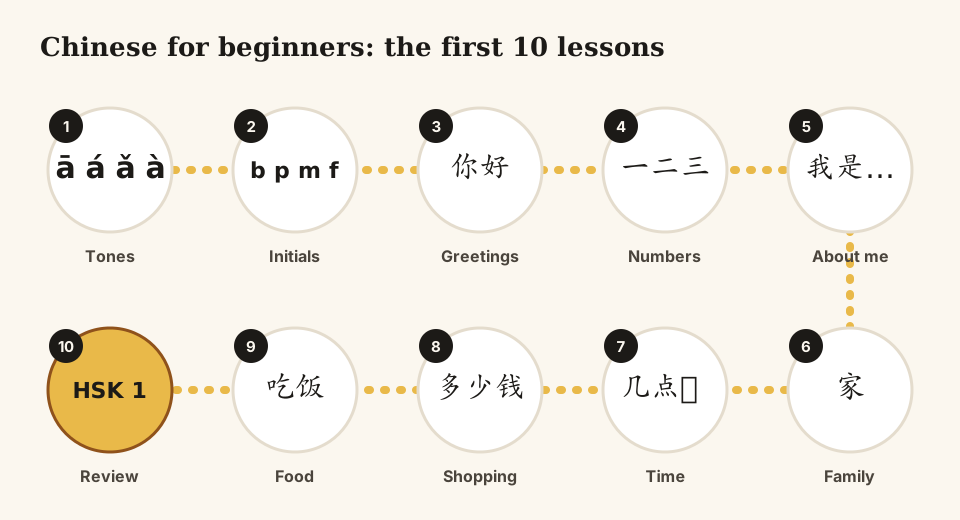
| Lesson | Topic | You will be able to… |
|---|---|---|
| 1 | The four tones and the neutral tone | Hear and produce the tones; say 你好, 谢谢, 再见 |
| 2 | Initials and finals: the whole pinyin system | Read any pinyin aloud; spot the tricky sounds q, x, zh, ü |
| 3 | Greetings and names | Greet people, ask and give names: 你叫什么名字?Nǐ jiào shénme míngzi? |
| 4 | Numbers 0–100 | Count, give your phone number, say your age |
| 5 | Introducing yourself | Nationality, job, where you live: 我是荷兰人。Wǒ shì Hélán rén. |
| 6 | Family | Talk about your family with 有 and 没有; your first measure word, 个 |
| 7 | Time and dates | Ask and tell the time, days of the week, make an appointment |
| 8 | Shopping | Prices with 多少钱?duōshao qián?, money, bargaining politely |
| 9 | Food and drink | Order in a restaurant; say what you like and don’t like |
| 10 | Review and first conversation | A ten-minute conversation in Chinese about yourself |
Along the way you learn your first characters: 人, 口, 大, 中, 你, 好, the numbers, and the ones in your own name. By lesson ten you recognise around 50 characters and can write the most important ones. See Chinese characters for how they work.
After lesson 10: the path to HSK 1
The next phase builds the full HSK 1 vocabulary (about 300 words in the new HSK 3.0) and the core grammar patterns: questions with 吗 and 呢, 的 for possession, 了 for completed actions, word order with time and place. Most beginners reach HSK 1 level after 30–40 lesson hours, two to four months at two lessons a week, plus regular practice. Some take the HSK 1 exam as a first milestone; others simply continue towards HSK 2. Both are fine.
Who this beginners’ course is for
- Complete beginners: you have never studied Chinese, or only picked up a few words.
- False beginners: you tried an app or a course years ago but never got past the basics. We start again, properly, without repeating what you already know.
- Adults with a specific reason: a partner’s family, colleagues in China, a trip, or simply a long-held wish.
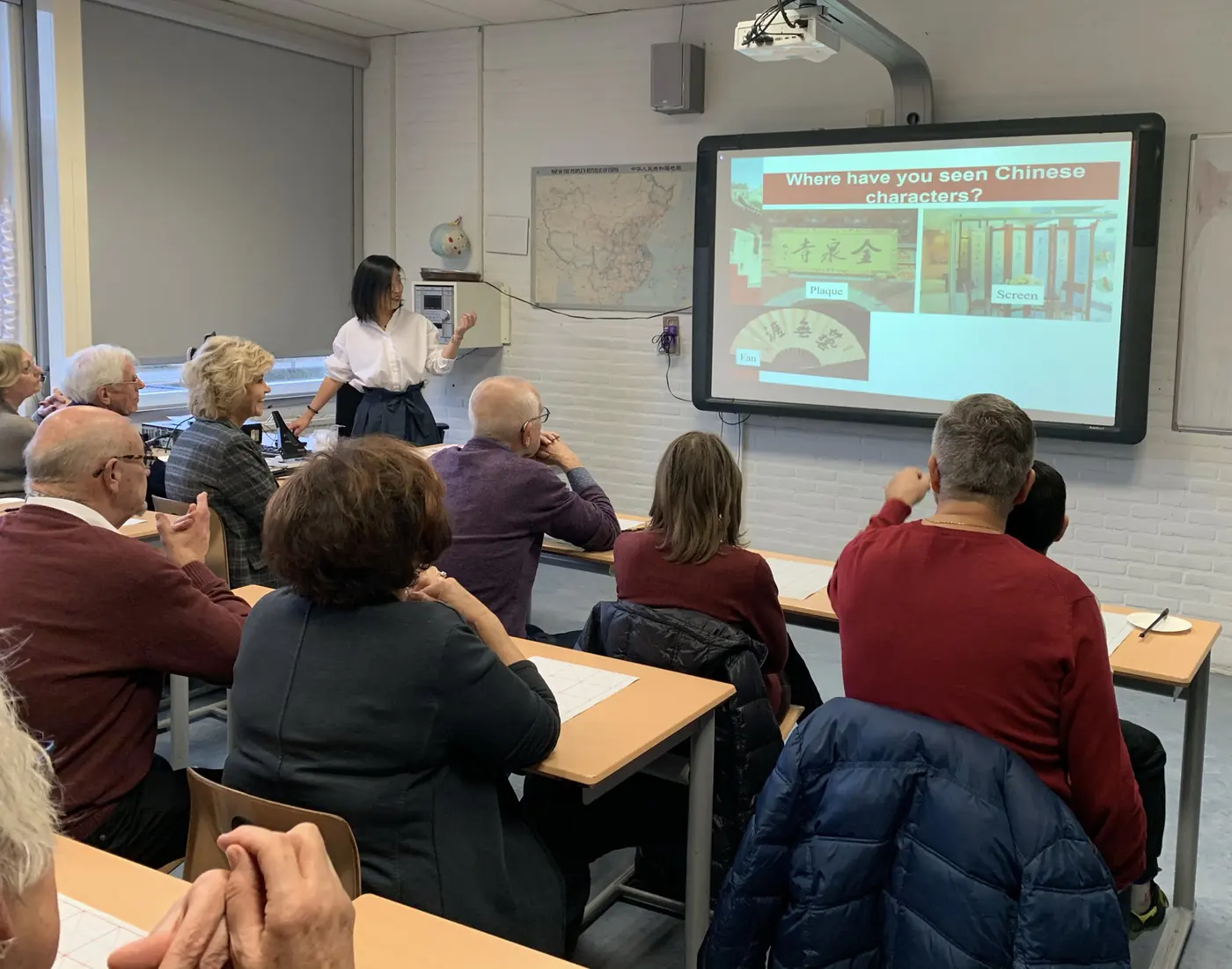
Lessons are for adults only and run one-to-one or in small groups. Small beginner Chinese classes are a sociable way to start, for example with a friend or colleague; one-to-one lessons move faster and fit any schedule. Both are available as online Mandarin classes for beginners or in person in Amsterdam by arrangement.
How the lessons work
Each lesson follows the KeSong approach: begin with your goals, learn in context, make it your own. In practice:
- A short warm-up conversation in Chinese, from lesson one.
- New sounds, words and one pattern, on a visual whiteboard with colour-coded tones.
- Lots of speaking: you use the pattern in your own sentences, and your tones are corrected on the spot.
- A small, clear homework task for the days in between.
You also get Zoey’s short Chinese stories for beginners, with pinyin and subtitles, for extra listening practice:
The video loads from YouTube when you press play.
How to start learning Chinese: a beginner’s checklist
- Decide why. A clear reason keeps you going in month three.
- Get the sounds right first: pinyin and tones, with feedback.
- Learn phrases you will really use: greetings, numbers, food. See basic Chinese phrases.
- Study a little every day: 15–20 minutes beats two hours on Sunday.
- Add characters gradually, in words you already know.
- Speak from week one, even if it is three sentences.
- Set a milestone: a trip, a dinner, HSK 1.
How long the whole journey takes is explained honestly in how long it takes to learn Chinese.
Price and practical details
- One-to-one: €60 per hour, online or in Amsterdam by arrangement.
- Small groups: fees depend on the number of learners and are confirmed after a short intake.
- Materials: digital slides and word lists are included; a notebook for characters is all you need to buy.
- No online payment: you arrange times and payment directly with Zoey after your enquiry.
Ready to begin with your first 你好nǐ hǎo? Whether you want basic Chinese lessons for a trip or a solid basic Chinese course as the start of a longer journey, send an enquiry and Zoey will suggest a schedule. This is the most structured way to learn Chinese for beginners: one clear step at a time, and Mandarin for beginners that sticks.
Frequently asked questions
How do I start learning Chinese?
Start with pinyin and the four tones, before you learn many words. Then learn a small set of everyday phrases and numbers, and use them in short conversations from the first week. Add characters gradually, a few at a time, in words you already know. A teacher in the first months makes sure your pronunciation is right from the beginning.
Do I need any previous knowledge to join a beginners' course?
No. The beginners' course assumes no Chinese at all. You do not need to know any characters, and you do not need to be "good at languages". What helps is regular practice: around 15–20 minutes a day between lessons.
How many lessons does a beginner need to reach HSK 1?
Typically 30–40 lesson hours, plus self-study, which is two to four months with two lessons a week. HSK 1 under the new HSK 3.0 covers about 300 words. Many beginners take the HSK 1 exam as a first milestone, but it is optional.
Is Chinese harder for beginners than other languages?
At the start it feels different rather than harder: tones and characters are new, but grammar is simple, with no conjugations or genders. Most beginners can hold a short conversation about themselves within two or three months. The long road is reading, which is why characters are introduced step by step.
Should I learn simplified or traditional characters as a beginner?
For most beginners, simplified characters, which are used in mainland China, Singapore and the HSK. If you plan to live in Taiwan or Hong Kong, traditional characters may suit you better. The spoken Mandarin you learn is the same either way.
Learn with Zoey
One-to-one or in a small group, online or in Amsterdam by arrangement. Tell Zoey what you want to achieve and she will suggest a plan.
Keep reading
-
Pinyin and the four tones
A clickable pinyin chart, the four tones, tone pairs and the classic mistakes.
-
How long does it take to learn Chinese?
Realistic hours per HSK level, what is hard, what is easy, and a 12-month plan.
-
Chinese characters
How the script works, radicals, stroke order and the 100 most common characters.
-
Basic Chinese phrases
Hello, thank you, sorry, I love you: with characters, pinyin and audio.
About the author
Zoey (Ziqiao Zang, 臧子乔) has taught Chinese as a foreign language since 2011 and in the Netherlands since 2016. She holds a Master of Teaching Chinese to Speakers of Other Languages from Zhejiang Normal University and set up and ran an official HSK online exam centre with more than 250 candidates.