Hello in Chinese, and the basic phrases you need first
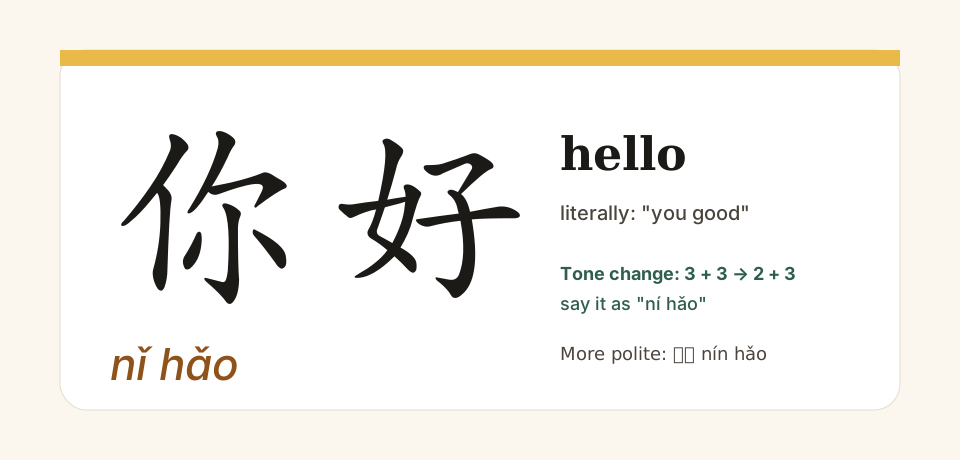
Hello in Chinese is 你好 (nǐ hǎo), pronounced almost like "nee how", and thank you is 谢谢 (xièxie). Below you find them and about sixty more basic Chinese phrases, each with characters, pinyin, audio and a teacher's note on when to use it: greetings, thanks, apologies, love, birthdays, New Year and the restaurant.
 By Zoey (Ziqiao Zang), Chinese teacher since 2011
Press ▶ next to any phrase to hear it read by your browser’s Chinese voice. For the best pronunciation, read the pinyin with its tone marks; if tones are new to you, take five minutes for pinyin and the four tones first.
Greetings
| ▶ | Chinese | Pinyin | English | When to use it |
|---|---|---|---|---|
| 你好 | nǐ hǎo | hello | The all-purpose greeting | |
| 您好 | nín hǎo | hello (polite) | Older people, customers, formal situations | |
| 大家好 | dàjiā hǎo | hello everyone | Starting a meeting, a class, a presentation | |
| 早上好 | zǎoshang hǎo | good morning | Until about 10 a.m.; casually just 早! | |
| 下午好 | xiàwǔ hǎo | good afternoon | Mostly in formal settings | |
| 晚上好 | wǎnshang hǎo | good evening | Events, formal greetings | |
| 晚安 | wǎn ān | good night | Before going to bed, not as a greeting | |
| 好久不见 | hǎojiǔ bú jiàn | long time no see | Meeting someone after a while | |
| 最近怎么样? | zuìjìn zěnmeyàng? | how have you been? | Friendly follow-up to hello | |
| 我很好,你呢? | wǒ hěn hǎo, nǐ ne? | I'm fine, and you? | The textbook answer, and a useful one | |
| 吃了吗? | chī le ma? | have you eaten? | A traditional, warm greeting, not a lunch invitation |
How do you say hello in Mandarin? 你好nǐ hǎo is correct everywhere, but you will hear Chinese friends greet each other differently: with the other person’s name, a quick 嗨hāi (hi), or a question about what they are doing. 你好 can even sound slightly formal between close friends.
Good morning in Chinese is 早上好zǎoshang hǎo, often shortened to a cheerful 早!zǎo!.
Goodbye
| ▶ | Chinese | Pinyin | English | When to use it |
|---|---|---|---|---|
| 再见 | zàijiàn | goodbye | Standard, literally "see again" | |
| 拜拜 | báibái | bye-bye | Very common and informal | |
| 明天见 | míngtiān jiàn | see you tomorrow | Colleagues, classmates | |
| 回头见 | huítóu jiàn | see you later | Casual | |
| 路上小心 | lùshang xiǎoxīn | take care on the way | When someone leaves for a journey |
Thank you, please and you’re welcome
| ▶ | Chinese | Pinyin | English | When to use it |
|---|---|---|---|---|
| 谢谢 | xièxie | thank you | Everyday thanks | |
| 谢谢你 | xièxie nǐ | thank you (to you) | A little warmer | |
| 太谢谢了 | tài xièxie le | thank you so much | Real gratitude | |
| 非常感谢 | fēicháng gǎnxiè | many thanks | Formal, also in writing | |
| 不客气 | bú kèqi | you're welcome | Standard reply | |
| 没事 | méi shì | no problem | Casual reply | |
| 请 | qǐng | please | Before a request: 请坐 (please sit) | |
| 麻烦你 | máfan nǐ | could you please… | Polite way to ask a favour |
Thank you in Chinese is 谢谢xièxie: first syllable fourth tone, second syllable light. Between close friends and family, Chinese people say thank you less often than English or Dutch speakers do; too much 谢谢 can even sound distant. With strangers, colleagues and in shops, it is always right.
Sorry and excuse me
| ▶ | Chinese | Pinyin | English | When to use it |
|---|---|---|---|---|
| 对不起 | duìbuqǐ | sorry | A real apology | |
| 不好意思 | bù hǎoyìsi | sorry / excuse me | Small things: bumping into someone, being late | |
| 没关系 | méi guānxi | it doesn't matter | Reply to an apology | |
| 请问 | qǐngwèn | excuse me, may I ask | Before a question to a stranger | |
| 我不懂 | wǒ bù dǒng | I don't understand | Essential | |
| 请再说一遍 | qǐng zài shuō yí biàn | please say that again | Essential | |
| 请说慢一点 | qǐng shuō màn yìdiǎn | please speak more slowly | Essential |
Love and affection
| ▶ | Chinese | Pinyin | English | Note |
|---|---|---|---|---|
| 我爱你 | wǒ ài nǐ | I love you | Strong; often written more than spoken | |
| 我喜欢你 | wǒ xǐhuan nǐ | I like you | Also a confession of love | |
| 我想你 | wǒ xiǎng nǐ | I miss you | Very common between partners | |
| 亲爱的 | qīn ài de | darling, dear | Between partners; also "Dear…" in letters | |
| 宝贝 | bǎobèi | baby, sweetheart | Affectionate nickname |
What do Chinese people say instead of “I love you”?
I love you in Chinese is 我爱你wǒ ài nǐ. It is correct, and young couples do use it, but many Chinese speakers, especially of older generations, rarely say it out loud: it feels heavy, almost theatrical. Love is more often expressed through care: 早点休息zǎo diǎn xiūxi (get some rest), 多穿点duō chuān diǎn (wear something warm), 吃饭了吗?chī fàn le ma? (have you eaten?). In messages you will also see the number 520 (wǔ èr líng), which sounds a little like 我爱你; 20 May is an unofficial day for couples.
How to write “I love you” in Chinese
Simplified: 我爱你. Traditional (Taiwan, Hong Kong): 我愛你. The traditional 愛 contains the heart 心; the simplified form lost it, which people like to joke about. More on the two scripts in Chinese characters.
Birthdays and congratulations
| ▶ | Chinese | Pinyin | English | When to use it |
|---|---|---|---|---|
| 生日快乐 | shēngrì kuàilè | happy birthday | Birthdays (also sung to the familiar tune) | |
| 祝你生日快乐 | zhù nǐ shēngrì kuàilè | I wish you a happy birthday | Fuller form, in cards | |
| 恭喜 | gōngxǐ | congratulations | New job, wedding, baby | |
| 干杯 | gānbēi | cheers! | Toasting; literally "dry the glass" | |
| 加油 | jiāyóu | good luck, go for it | Encouraging someone before an exam or match | |
| 一路顺风 | yílù shùnfēng | have a good trip | Seeing someone off |
Happy birthday in Mandarin is 生日快乐shēngrì kuàilè. Chinese people traditionally also eat long noodles (长寿面) on their birthday, for a long life.
Chinese New Year wishes
| ▶ | Chinese | Pinyin | English | Note |
|---|---|---|---|---|
| 新年快乐 | xīnnián kuàilè | happy New Year | For both 1 January and Chinese New Year | |
| 春节快乐 | Chūnjié kuàilè | happy Spring Festival | Specifically Chinese New Year | |
| 恭喜发财 | gōngxǐ fācái | wishing you prosperity | Classic New Year wish | |
| 万事如意 | wànshì rúyì | may everything go as you wish | In cards and toasts | |
| 身体健康 | shēntǐ jiànkāng | good health | Especially to older relatives |
More about the festival, including the 2027 date, in Chinese New Year 2027.
At the restaurant
| ▶ | Chinese | Pinyin | English | Note |
|---|---|---|---|---|
| 服务员! | fúwùyuán! | waiter! / excuse me! | Calling staff; normal in China | |
| 菜单 | càidān | menu | 请给我菜单 (the menu, please) | |
| 我要这个 | wǒ yào zhège | I'd like this one | Point at the menu | |
| 不要辣 | bú yào là | not spicy, please | Useful in Sichuan restaurants | |
| 好吃 | hǎochī | delicious | Compliment the food | |
| 买单 | mǎidān | the bill, please | Also 结账 (jiézhàng) | |
| 多少钱? | duōshao qián? | how much is it? | Shops and markets |
Introducing yourself
| ▶ | Chinese | Pinyin | English | Note |
|---|---|---|---|---|
| 我叫… | wǒ jiào… | my name is… | Followed by your name | |
| 你叫什么名字? | nǐ jiào shénme míngzi? | what's your name? | Informal | |
| 我是英国人 | wǒ shì Yīngguó rén | I'm British | Swap the country: 美国 (US), 荷兰 (Netherlands) | |
| 我在学中文 | wǒ zài xué Zhōngwén | I'm learning Chinese | Earns you a smile and slower speech | |
| 认识你很高兴 | rènshi nǐ hěn gāoxìng | nice to meet you | After introductions | |
| 中国 | Zhōngguó | China | 中 middle + 国 country | |
| 中文 | Zhōngwén | Chinese (language) | Also 汉语 (Hànyǔ) |
The video loads from YouTube when you press play.
How many words do you need to be fluent?
People often ask how many words in Chinese you need to be fluent. For everyday conversation, around 2,000 words (HSK 4 in the new HSK 3.0) takes you a long way; reading newspapers comfortably needs 3,500–5,000. But fluency is speed and confidence as much as vocabulary: a few hundred well-practised phrases, like the ones above, already carry you through many daily situations. See how long it takes to learn Chinese for realistic timelines.
Next steps
Count to ten and beyond in Chinese numbers, get the sounds right with pinyin and the four tones, or start properly with my course for beginners, where these phrases are part of the very first lessons.
Frequently asked questions
What do Chinese people say instead of "I love you"?
我爱你 (wǒ ài nǐ) exists, but many Chinese speakers find it very strong and rarely say it out loud. Affection is more often shown through care and actions, or softer words: 我喜欢你 (I like you), 我想你 (I miss you), or practical concern such as 早点休息 (get some rest) and 多穿点 (wear something warm).
How do you write "I love you" in Chinese?
In simplified characters: 我爱你, pronounced wǒ ài nǐ. 我 means I, 爱 means love and 你 means you. In traditional characters, used in Taiwan and Hong Kong, love is written 愛, with the heart radical 心 in the middle: 我愛你.
How do you say hello in Mandarin?
The standard greeting is 你好 (nǐ hǎo). To be more polite, for example with older people or customers, say 您好 (nín hǎo). In daily life friends often skip 你好 and greet with a question such as 吃了吗? (have you eaten?) or simply call the person's name.
How many words do you need to be fluent in Chinese?
For everyday conversation, about 2,000 words (HSK 4 under HSK 3.0) gets you a long way. Reading newspapers comfortably needs around 3,500–5,000 words. But fluency is about using words quickly and naturally, so a few hundred well-practised phrases already let you handle many daily situations.
How do you say thank you in Chinese?
谢谢 (xièxie), with the second syllable light. To thank someone warmly, say 太谢谢了 (thank you so much) or 非常感谢 (fēicháng gǎnxiè, many thanks). The usual reply is 不客气 (bú kèqi, you're welcome) or 没事 (méi shì, no problem).
Learn with Zoey
One-to-one or in a small group, online or in Amsterdam by arrangement. Tell Zoey what you want to achieve and she will suggest a plan.
Keep reading
-
Pinyin and the four tones
A clickable pinyin chart, the four tones, tone pairs and the classic mistakes.
-
Chinese numbers
Count from 1 to 100 and beyond, hand gestures and lucky numbers.
-
Beginners
Start from zero: pinyin, tones, your first characters and real conversations.
-
Chinese names
How Chinese names work, common surnames, and how to choose your own name.
About the author
Zoey (Ziqiao Zang, 臧子乔) has taught Chinese as a foreign language since 2011 and in the Netherlands since 2016. She holds a Master of Teaching Chinese to Speakers of Other Languages from Zhejiang Normal University and set up and ran an official HSK online exam centre with more than 250 candidates.