How long does it take to learn Chinese? A teacher's honest answer
How long does it take to learn Chinese? For an adult English or Dutch speaker, basic conversation (HSK 2) takes about 160–240 hours of study, comfortable everyday Chinese (HSK 4) about 600–900 hours, and professional fluency around 2,200 classroom hours plus self-study. At one hour a day, that is roughly six months, two years and five years or more.
 By Zoey (Ziqiao Zang), Chinese teacher since 2011
“How long will it take me?” is the question I hear most in a first lesson, usually followed by “and is Chinese really that hard?” The honest answer is: it depends on your goal, the hours you put in and how you study. But that answer is not much help, so this article gives real numbers, explains where they come from and shows what you can reach in one year.
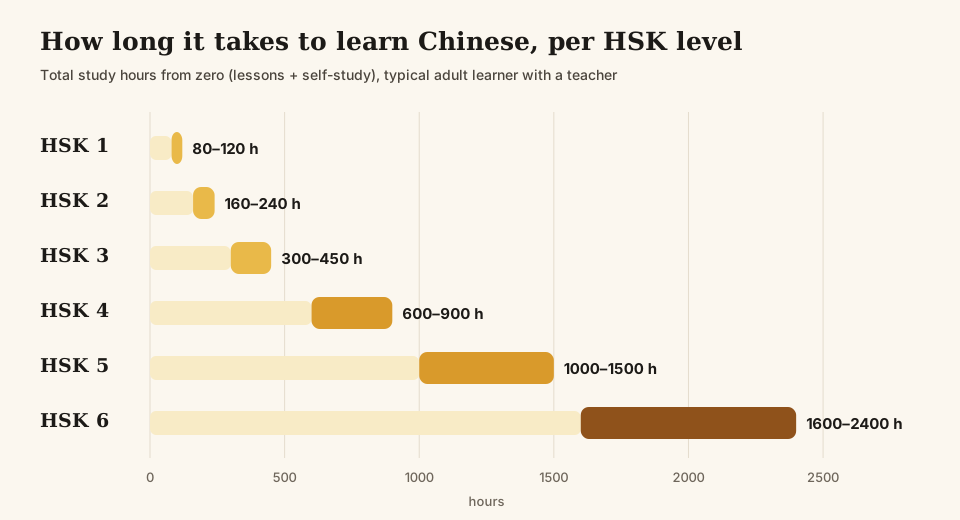
How long it takes to learn Chinese, per HSK level
The HSK levels are the clearest way to measure progress, so let’s use them. The ranges below are total study hours from zero: lessons plus self-study, for an adult English or Dutch speaker learning with a teacher. They are based on the new HSK 3.0 word lists, which are larger than the old ones, and on the hours my students typically need.
| Level | What you can do | Total study hours (cumulative) | At ~1 hour a day |
|---|---|---|---|
| HSK 1 | Introduce yourself, numbers, time, simple questions | 80–120 | 3–4 months |
| HSK 2 | Short everyday conversations: shopping, plans, directions | 160–240 | 6–8 months |
| HSK 3 | Get by in daily life and travel; read simple texts without pinyin | 300–450 | 10–15 months |
| HSK 4 | Talk about many topics; follow most everyday conversations | 600–900 | 1.5–2.5 years |
| HSK 5 | Read newspapers, watch films, give a structured talk | 1,000–1,500 | 3–4 years |
| HSK 6 | Understand complex texts, express yourself fluently | 1,600–2,400 | 4.5–6.5 years |
What the Foreign Service Institute says
The US Foreign Service Institute (FSI), which trains American diplomats, places Mandarin in its hardest category for English speakers, together with Cantonese, Japanese, Korean and Arabic. Its estimate is 88 weeks, about 2,200 classroom hours, to reach professional working proficiency, compared with about 24–30 weeks for Dutch, Spanish or French. FSI students study full-time in small classes with extra self-study every day, so for a part-time learner, 2,200 hours is a minimum, not a promise. That level corresponds roughly to HSK 6 or above.
Is it different for Dutch speakers?
Hardly. Dutch and English are both Germanic languages with no tones and an alphabet, so Dutch speakers start from the same place as English speakers. Two small differences I notice in class: the Dutch g and ch make the Chinese h (as in 好hǎo) easy, and many Dutch learners are already used to learning several languages at school, which helps with study habits. Dutch speakers do sometimes struggle with the Chinese x and q, which have no Dutch equivalent. The total hours are the same.
Is Chinese hard to learn? What is hard and what is easy
Chinese has a reputation for being impossible. It isn’t. It is a language with a few genuinely hard parts and several surprisingly easy ones.
What is hard
1. Tones. Mandarin has four tones plus a neutral tone, and the tone changes the meaning: 妈mā (mother), 麻má (hemp), 马mǎ (horse), 骂mà (to scold). For English and Dutch speakers, who use pitch only for emotion and questions, this takes months of practice. Read pinyin and the four tones for a full explanation.
2. Characters. There is no alphabet. You need about 300 characters to read simple texts, around 1,000 for HSK 4 and 2,000–3,000 to read a newspaper comfortably. Each must be recognised, and many written by hand. See Chinese characters.
3. Sounds that don’t exist in English or Dutch. zh, ch, sh, r, x, q, j and the vowel ü all need deliberate practice.
4. Few familiar words. In Spanish or German you recognise hundreds of words from day one. In Chinese almost nothing is familiar, apart from a handful of loanwords such as 咖啡kāfēi (coffee) and 沙发shāfā (sofa).
What is easy
1. No conjugations. 我去wǒ qù “I go”, 他去tā qù “he goes”, 我们去wǒmen qù “we go”. The verb never changes.
2. No genders, no articles, no plural endings. No de/het, no the/a, no -s.
3. Simple tenses. Time is expressed with words like “yesterday” or “tomorrow” and a few particles such as 了le, not with verb forms.
4. Logical word building. Once you know 电diàn (electricity), you can guess 电脑diànnǎo (computer, literally “electric brain”) and 电话diànhuà (telephone, “electric speech”).
Chinese vs Japanese vs Dutch
People often ask whether Chinese or Japanese is easier. And many Dutch learners ask: is Chinese harder than Dutch?
| Chinese (Mandarin) | Japanese | Dutch (for English speakers) | |
|---|---|---|---|
| Pronunciation | Hard: four tones | Fairly easy: no tones, simple sounds | Medium: g, ui, eu |
| Grammar | Easy: no conjugation, fixed word order | Hard: verb forms, particles, politeness levels | Medium: genders, word order rules |
| Writing | Hard: characters | Very hard: kanji plus two syllabaries | Easy: Latin alphabet |
| FSI estimate for English speakers | ~2,200 hours | ~2,200 hours (plus extra) | ~600–750 hours |
So is Chinese harder than Japanese? To speak, usually yes, at first. To read, Japanese is harder, because kanji often have several readings and are mixed with two other scripts. If your goal is conversation, Chinese grammar’s simplicity is a real advantage once you have the tones.
Is Chinese harder than Dutch? For an English speaker, much harder: Dutch takes perhaps a third of the hours. For a Dutch native speaker learning Chinese, the comparison is with English: Chinese takes three to four times as long as English did, because it shares nothing with Dutch.
Can you learn Chinese in 3 months, 1 month or 1 year?
These questions come up so often that they deserve straight answers.
In 30 days, with daily practice, you can learn pinyin, the four tones and survival phrases: greetings, numbers, ordering food, asking directions. Enough for a trip. Not enough for a conversation about anything else.
In 3 months, at about an hour a day, you can reach roughly HSK 1: introduce yourself, talk about your family and work, ask simple questions, read a few dozen characters. A strong foundation, if your tones are good.
In 1 year, part-time, most adults reach HSK 2–3 and can manage everyday conversations. Full-time immersion, such as a year at a Chinese university, can bring a motivated learner to HSK 4–5.
Fluency in a year is not realistic for an adult, whatever an app advert says. But meaningful, useful Chinese in a year is very realistic.
A 12-month roadmap for adult learners
This plan assumes two lessons a week plus about 20–30 minutes of practice a day, roughly 300–400 hours in total.
| Months | Focus | By the end you can… |
|---|---|---|
| 1–2 | Pinyin, the four tones, tone pairs, numbers, greetings | Read pinyin aloud correctly; introduce yourself; count to 100 |
| 3–4 | Core HSK 1 vocabulary, basic sentence patterns, first 100 characters | Talk about family, work, time and dates; read simple sentences |
| 5–6 | HSK 2 vocabulary, questions, 了le and 过guo, measure words | Shop, order food, make plans; HSK 1 exam if you want a milestone |
| 7–9 | Listening practice with stories, 300+ characters, short writing | Follow slow conversations; write short messages |
| 10–12 | HSK 3 vocabulary, reading without pinyin, longer conversations | Handle daily life and travel in Chinese; HSK 2 or 3 exam |
Two tips that make this plan work: study a little every day rather than a lot once a week, and speak from the first week, even if it is only three sentences. My course for beginners follows exactly this order.
What speeds up learning Chinese
- A teacher for pronunciation, especially in the first months. Apps cannot hear you.
- Daily contact: 15 minutes of listening or flashcards every day beats two hours on Sunday.
- Spaced repetition (Anki, Pleco flashcards) for characters and vocabulary.
- Stories and real content at your level, such as graded readers or Chinese stories with subtitles.
- A clear goal with a date: an HSK exam, a trip, a presentation. See the HSK exam guide.
- Speaking, even badly: confidence comes from practice, not from waiting until you are ready.
So, how long will it take you?
Take your goal, find it in the table above and divide the hours by what you can realistically study per week. That is your answer, give or take a few months. If the number looks long, remember that useful Chinese starts much earlier than fluency: after a few months you can already surprise a Chinese colleague with a proper introduction and a correct 谢谢xièxie.
If you would like a personal estimate, tell me your goal and your available time. After a short intake I can tell you what is realistic, and how to get there.
Frequently asked questions
How long does it take to fluently learn Chinese?
For an English or Dutch speaker, professional fluency typically takes around 2,200 hours of classroom study plus a lot of self-study, which is how the US Foreign Service Institute measures it. For most adults studying part-time, that means five years or more. Fluency in everyday conversation (around HSK 4) comes much earlier, after roughly 600–900 hours.
How long does it take to fluently learn Mandarin?
The same as Chinese, because Mandarin is the standard form of Chinese that learners study. Expect around 600–900 hours for comfortable everyday Mandarin and well over 2,000 hours for professional fluency. Living in a Mandarin-speaking environment or studying full-time shortens the calendar time, but not the number of hours.
Is it possible to learn Chinese in 1 year?
You can learn a lot of Chinese in one year. Studying part-time (about an hour a day with two lessons a week), most adults reach HSK 2 or 3 and can manage everyday conversations. Full-time intensive study, such as a year at a university in China, can take a motivated learner to HSK 4 or 5. Full fluency in one year is unrealistic.
Can I learn Mandarin in 3 months?
In three months you can learn the foundations: pinyin, the four tones, a few hundred words and simple conversations about yourself, your work and daily needs. With an hour a day that is roughly HSK 1 level. Three months is a great start, and it is enough for a trip to China, but not for fluency.
Can I learn Mandarin in 1 month or 30 days?
In 30 days you can learn pinyin, the four tones and a set of survival phrases: greetings, numbers, ordering food and asking for directions. That is useful for travel. Courses promising fluency in 30 days are not realistic; Chinese needs time for your ear and memory to adjust to tones and characters.
Which is harder, Chinese or Japanese?
Both are among the hardest languages for English and Dutch speakers. Chinese is harder to pronounce, because of the tones, while Japanese is harder to read and has more complex grammar and politeness levels. Chinese grammar is simpler. Many learners find spoken Chinese harder at first, and written Japanese harder in the long run.
What is the 3rd hardest language in the world?
There is no official ranking. The US Foreign Service Institute puts Mandarin, Cantonese, Japanese, Korean and Arabic in its hardest category for English speakers, all needing about 88 weeks of full-time study. Popular lists usually name Mandarin first, followed by Arabic and Japanese or Korean, but the order depends on your native language.
Learn with Zoey
One-to-one or in a small group, online or in Amsterdam by arrangement. Tell Zoey what you want to achieve and she will suggest a plan.
Keep reading
-
Beginners
Start from zero: pinyin, tones, your first characters and real conversations.
-
HSK exam guide
Levels, HSK 3.0, test centres, dates, fees and registration in the Netherlands.
-
Pinyin and the four tones
A clickable pinyin chart, the four tones, tone pairs and the classic mistakes.
-
Chinese characters
How the script works, radicals, stroke order and the 100 most common characters.
About the author
Zoey (Ziqiao Zang, 臧子乔) has taught Chinese as a foreign language since 2011 and in the Netherlands since 2016. She holds a Master of Teaching Chinese to Speakers of Other Languages from Zhejiang Normal University and set up and ran an official HSK online exam centre with more than 250 candidates.