Pinyin and the four tones of Mandarin Chinese
Pinyin (拼音 pīnyīn, "spelled sounds") is the official system for writing Mandarin pronunciation with Latin letters. It shows every syllable's sound and tone, and it is how you start reading, look words up and type Chinese. This guide has a clickable pinyin chart with audio, the four Chinese tones, tone-pair drills and the mistakes I hear most often.
 By Zoey (Ziqiao Zang), Chinese teacher since 2011
What is pinyin?
Every Chinese syllable consists of up to three parts: an initial (the consonant at the start), a final (the vowel part) and a tone. Pinyin writes all three. In mǎ (马mǎ, horse), m is the initial, a the final, and the mark ˇ the third tone.
Pinyin was introduced in China in 1958 and has been the international standard for romanising Mandarin since 1982. It replaced older systems such as Wade-Giles, which is why you still see spellings like Peking (now Běijīng) and Tao (now dào) in older books. In Taiwan, pronunciation is mainly taught with a different system, zhuyin or bopomofo (ㄅㄆㄇㄈ), but pinyin is what you need for mainland Mandarin and the HSK.
There are 21 initials and about 35 finals, which combine into roughly 400 possible syllables. With four tones, that gives about 1,300 distinct sounds, far fewer than English, which is why tones matter so much.
The pinyin chart (with audio)
This pinyin chart lists every common Mandarin syllable, grouped by initial. Press a syllable to hear a character with that sound; hover to see which one. Use it to check how a syllable sounds, or go through one row a day to train your ear.
| Initial | ▶ |
|---|---|
| b | |
| p | |
| m | |
| f | |
| d | |
| t | |
| n | |
| l | |
| g | |
| k | |
| h | |
| j | |
| q | |
| x | |
| zh | |
| ch | |
| sh | |
| r | |
| z | |
| c | |
| s | |
| no initial |
A few spelling rules make the chart easier to read:
- y and w are written when a syllable starts with i or u: i → yi, ia → ya, u → wu, uo → wo.
- ü is written u after j, q, x and y: ju, qu, xu, yu all have the ü sound. Only after n and l do you see the dots: nǚ (woman), lǜ (green).
- iu, ui, un are short for iou, uei, uen: liù sounds close to “lyo”, duì close to “dway”.
The four Chinese tones
Mandarin has four tones plus a neutral tone. The tone is the pitch pattern of the syllable, and it changes the meaning completely.
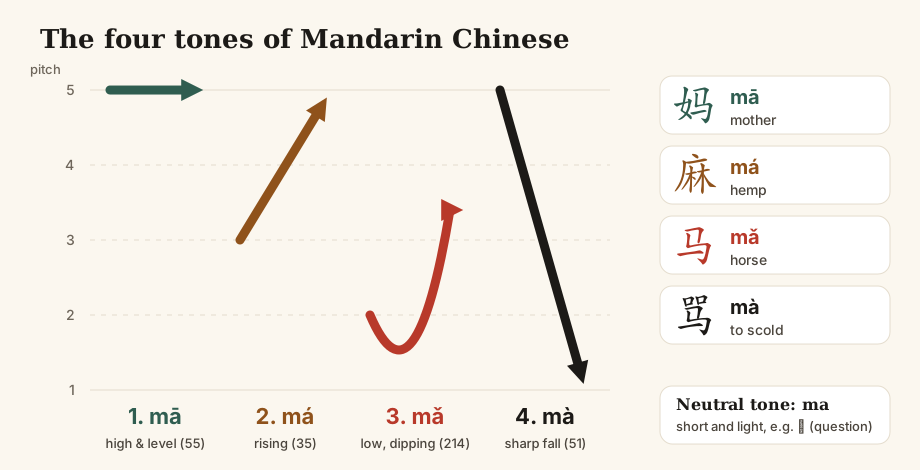
| Tone | Mark | Pitch | Example | Meaning |
|---|---|---|---|---|
| 1st | ā | High and level, held | 妈mā | mother |
| 2nd | á | Rising, like a surprised “what?” | 麻má | hemp; numb |
| 3rd | ǎ | Low, dipping (then rising if alone) | 马mǎ | horse |
| 4th | à | Sharp fall, like a firm “no!” | 骂mà | to scold |
| Neutral | a | Short and light | 吗ma | question particle |
Tip: use your hand. Draw a flat line for the first tone, an upward stroke for the second, a dip for the third and a downward chop for the fourth. It sounds silly, and it works: gesture helps your voice find the pitch.
The third tone in real speech
In textbooks the third tone dips and rises (214). In real speech it is usually just low (21), the “half third tone”, and only rises at the end of a sentence or when said alone. Learners who dip and rise on every third tone sound slow and unnatural. Listen to 我很好wǒ hěn hǎo: only the last syllable rises.
Tone changes (tone sandhi)
Some tones change depending on the next syllable. Three rules cover almost everything:
- Third + third → second + third. 你好nǐ hǎo is pronounced ní hǎo. Pinyin still writes nǐ hǎo.
- 不 bù before a fourth tone → bú. 不是bú shì (is not), 不对bú duì (not right).
- 一 yī changes too: yí before a fourth tone (一个yí ge), yì before other tones (一天yì tiān), and yī when counting or at the end.
The video loads from YouTube when you press play.
In this short story I explain exactly these tone changes, with examples you will use every day.
Tone pairs: the drill that works
Most Chinese words have two syllables, so tones are easier to learn in pairs than alone. There are twenty combinations. Practise them as a set, one row a day:
| ▶ | Word | Pinyin | Meaning | Tone pair |
|---|---|---|---|---|
| 飞机 | fēijī | aeroplane | 1 + 1 | |
| 中国 | Zhōngguó | China | 1 + 2 | |
| 铅笔 | qiānbǐ | pencil | 1 + 3 | |
| 音乐 | yīnyuè | music | 1 + 4 | |
| 妈妈 | māma | mum | 1 + neutral | |
| 明天 | míngtiān | tomorrow | 2 + 1 | |
| 学习 | xuéxí | to study | 2 + 2 | |
| 苹果 | píngguǒ | apple | 2 + 3 | |
| 学校 | xuéxiào | school | 2 + 4 | |
| 朋友 | péngyou | friend | 2 + neutral | |
| 老师 | lǎoshī | teacher | 3 + 1 | |
| 女儿 | nǚ’ér | daughter | 3 + 2 | |
| 你好 | nǐ hǎo | hello | 3 + 3 (→ 2 + 3) | |
| 米饭 | mǐfàn | cooked rice | 3 + 4 | |
| 我们 | wǒmen | we | 3 + neutral | |
| 面包 | miànbāo | bread | 4 + 1 | |
| 大学 | dàxué | university | 4 + 2 | |
| 汉语 | Hànyǔ | Chinese language | 4 + 3 | |
| 再见 | zàijiàn | goodbye | 4 + 4 | |
| 爸爸 | bàba | dad | 4 + neutral |
Say each word three times, then make your own sentence with it. Record one row and listen back a day later: you will hear things you missed while speaking.
Chinese pronunciation: the sounds that need attention
Most pinyin letters sound roughly as an English speaker expects. These do not:
| Pinyin | Sounds like | Example | Watch out |
|---|---|---|---|
| q | “ch” in cheese, lips spread | 七qī seven | Not “kw” |
| x | between “s” and “sh”, tongue flat | 谢谢xièxie thank you | Not “ks” |
| j | “j” in jeep, lips spread | 几jǐ how many | Softer than English j |
| zh, ch, sh | like j, ch, sh with the tongue curled back | 中zhōng, 吃chī, 是shì | Retroflex: tongue tip up |
| r | between English “r” and the “s” in pleasure | 热rè hot | Not a rolled r |
| c | “ts” in cats | 菜cài dish | Not “k” or “s” |
| z | “ds” in beds | 在zài at | Not English z |
| ü | “ee” with rounded lips (French u) | 绿lǜ green | Written u after j, q, x, y |
| e | “uh”, from the back of the throat | 喝hē to drink | Not “eh” |
| ian | “yen” | 天tiān day, sky | Not “yan” |
Common mistakes for English and Dutch speakers
- Treating tones as optional. A wrong tone is not an accent; it can be a different word. 买mǎi is “buy”, 卖mài is “sell”.
- Question intonation. English and Dutch speakers raise their voice at the end of a question. In Chinese that can change the last tone. Use 吗ma to make the question, and keep your tones.
- Fourth tones that don’t fall far enough. Start high, drop all the way down. Short and decisive.
- Every third tone fully dipped. In connected speech, keep it low.
- Reading pinyin as English. xie is not “ksee”, cai is not “kai”, zhi is not “zee”.
Dutch speakers have one advantage: the Chinese h is the Dutch ch (as in lachen), and ü is the Dutch uu.
Cantonese tones and other systems
You may read that Cantonese has nine tones (or six, depending on how you count). That is a different language; the four tones here are for Mandarin, the standard language. Cantonese also uses its own romanisation, Jyutping. See Mandarin vs Cantonese.
Typing Chinese with pinyin
On a phone or computer, add the Chinese (Simplified) pinyin keyboard. Type pinyin without tones, for example nihao, and choose 你好 from the suggestions. The Apple pinyin keyboard and Windows Microsoft Pinyin both work this way. It is also how the writing section of the internet-based HSK works.
Learning pinyin and tones with a teacher
Pinyin can be learned in a few weeks; good tones take months of practice with feedback. In my course for beginners the first lessons focus on exactly that, so you never have to unlearn bad habits. After that, characters become much easier too: see Chinese characters, and put your tones to work with basic Chinese phrases.
Frequently asked questions
What are the four tones in Chinese?
Mandarin has four main tones plus a neutral tone. The first tone is high and level (mā), the second rises (má), the third dips low and rises (mǎ) and the fourth falls sharply (mà). The neutral tone is short and light (ma). The tone changes the meaning of a syllable, so mā means mother and mǎ means horse.
Is pinyin the same as Chinese?
No. Pinyin is a tool to write how Chinese sounds, not a replacement for Chinese characters. Chinese people read and write characters; pinyin is used to teach pronunciation, in dictionaries, for typing on phones and computers, and on some signs. Learners use pinyin heavily at first and rely on it less as they learn characters.
What is the best way to learn Chinese tones?
Learn each tone with a gesture, then practise tones in pairs rather than alone, because real words combine two syllables. Record yourself and compare with a native model, and get regular feedback from a teacher, because most learners cannot yet hear their own tone mistakes. Ten minutes of tone-pair practice a day in the first months makes a lasting difference.
How do you type pinyin with tone marks?
On a computer or phone, add a Chinese (Simplified) pinyin keyboard: you type pinyin without tones and choose the character. To type tone marks themselves, many pinyin keyboards accept a number after the vowel (ma3 becomes mǎ), and the Apple pinyin keyboard lets you hold a vowel to choose the accented version.
Do Chinese people use pinyin?
Yes, every day, but mostly for typing. Children learn pinyin in their first year of school before characters, and most people type on phones and computers using a pinyin keyboard. Pinyin also appears on street signs, in dictionaries and in children's books. Taiwan mainly uses a different system, zhuyin (bopomofo), for teaching pronunciation.
Learn with Zoey
One-to-one or in a small group, online or in Amsterdam by arrangement. Tell Zoey what you want to achieve and she will suggest a plan.
Keep reading
-
Beginners
Start from zero: pinyin, tones, your first characters and real conversations.
-
Chinese characters
How the script works, radicals, stroke order and the 100 most common characters.
-
Basic Chinese phrases
Hello, thank you, sorry, I love you: with characters, pinyin and audio.
-
How long does it take to learn Chinese?
Realistic hours per HSK level, what is hard, what is easy, and a 12-month plan.
About the author
Zoey (Ziqiao Zang, 臧子乔) has taught Chinese as a foreign language since 2011 and in the Netherlands since 2016. She holds a Master of Teaching Chinese to Speakers of Other Languages from Zhejiang Normal University and set up and ran an official HSK online exam centre with more than 250 candidates.