Chinese names: how they work, and how to get your own
Chinese names put the family name first and the given name second: in 王静怡 (Wáng Jìngyí), Wáng is the surname and Jìngyí the given name. Surnames are usually one character, given names one or two, and every character is chosen for its meaning. Here you find the most common surnames, typical female and male names, and how to choose a good Chinese name for yourself.
 By Zoey (Ziqiao Zang), Chinese teacher since 2011
How Chinese names work
A Chinese name follows a fixed order: surname first, given name second. 王静怡 is Ms Wang, given name Jingyi. In English contexts people sometimes reverse the order to fit Western forms, which causes endless confusion on conference badges.
- Surnames (姓 xìng) are almost always one character: 王, 李, 张. A few have two, such as 欧阳 (Ōuyáng) and 司马 (Sīmǎ).
- Given names (名 míng) have one or two characters, chosen by parents for their meaning, sound and sometimes the number of strokes.
- No middle names, and women traditionally keep their own surname after marriage.
- Generation names: in some families, siblings or cousins share one character of their given name.
- Forms of address: friends use the full name or the given name; colleagues use surname plus title (王经理, Manager Wang); and familiar nicknames add 小 (little) or 老 (old): 小王, 老李.
The most common Chinese surnames
China has thousands of surnames, but a handful cover a huge share of the population. A traditional phrase, 张王李赵遍地刘, says Zhang, Wang, Li, Zhao and Liu are everywhere.
| ▶ | Surname | Pinyin | Meaning of the character | Note |
|---|---|---|---|---|
| 王 | Wáng | king | Among the two most common surnames | |
| 李 | Lǐ | plum tree | Among the two most common surnames | |
| 张 | Zhāng | to stretch, to open | ||
| 刘 | Liú | (historic) axe | Surname of the Han emperors | |
| 陈 | Chén | to display; old | Very common in the south | |
| 杨 | Yáng | poplar | ||
| 黄 | Huáng | yellow | Spelled Wong in Cantonese | |
| 赵 | Zhào | (name of an ancient state) | ||
| 吴 | Wú | (name of an ancient state) | Spelled Ng or Woo in some regions | |
| 周 | Zhōu | circuit; complete |
These Chinese surnames look different in Hong Kong, Taiwan or Southeast Asia because they are romanised from other languages or systems: 黄 is Huang in pinyin, Wong in Cantonese, Ng or Oei in some Hokkien-speaking communities.
Female and male Chinese names
Given names are chosen for their meaning. Some characters are typical for girls, others for boys, and many are used for both.
Typical characters in female names
| ▶ | Character | Pinyin | Meaning |
|---|---|---|---|
| 美 | měi | beautiful | |
| 静 | jìng | quiet, calm | |
| 婷 | tíng | graceful | |
| 慧 | huì | wise | |
| 雪 | xuě | snow | |
| 欣 | xīn | joyful | |
| 怡 | yí | happy, harmonious | |
| 琳 | lín | beautiful jade | |
| 雨 | yǔ | rain | |
| 佳 | jiā | excellent |
Examples of Chinese female names: 王静怡 (Wáng Jìngyí, “calm and joyful”), 李雪婷 (Lǐ Xuětíng), 陈慧琳 (Chén Huìlín).
Typical characters in male names
| ▶ | Character | Pinyin | Meaning | |
|---|---|---|---|---|
| 伟 | wěi | great | ||
| 强 | qiáng | strong | ||
| 杰 | jié | outstanding | ||
| 浩 | hào | vast | ||
| 明 | míng | bright | ||
| 宇 | yǔ | universe | ||
| 博 | bó | broad, learned | ||
| 涛 | tāo | great waves | ||
| 鹏 | péng | roc (mythical bird) | Soaring ambition | |
| 磊 | lěi | heap of stones | Upright, open-hearted |
Examples: 张伟 (Zhāng Wěi, one of the most common full names in China), 刘浩然 (Liú Hàorán), 赵明杰 (Zhào Míngjié). Fashions change: names like 伟 and 强 were very popular a generation ago; today many parents choose more literary combinations like 子轩 or 梓涵.
Your name in Chinese
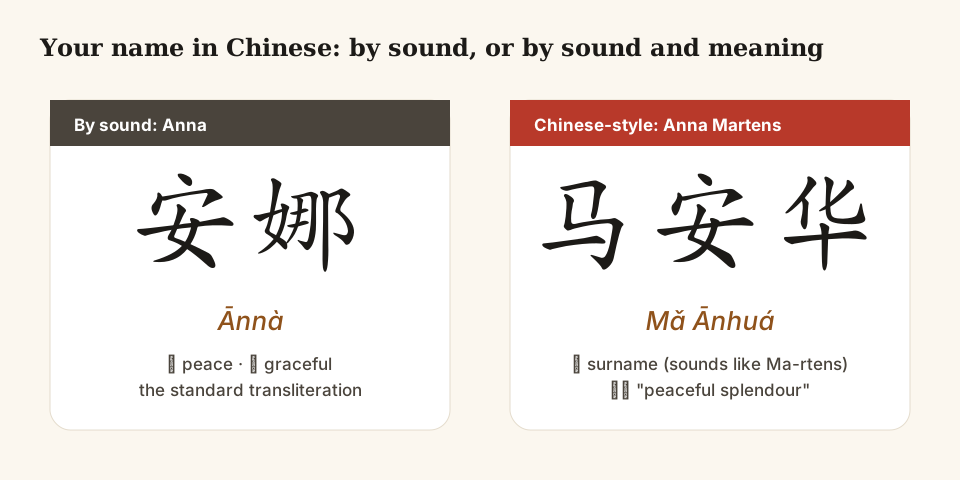
There are two ways to get your name in Chinese.
1. By sound (transliteration). Foreign names have standard Chinese forms, used in newspapers and official documents:
| ▶ | Name | Chinese | Pinyin |
|---|---|---|---|
| Anna | 安娜 | Ānnà | |
| David | 大卫 | Dàwèi | |
| Maria | 玛丽亚 | Mǎlìyà | |
| Peter | 彼得 | Bǐdé | |
| Thomas | 托马斯 | Tuōmǎsī | |
| Emma | 艾玛 | Àimǎ | |
| Mark | 马克 | Mǎkè | |
| Sophie | 索菲 | Suǒfēi |
These are recognisable and correct, but they mark you as a foreigner, and they can be long.
2. A Chinese-style name. Many learners and professionals choose a name that works like a Chinese name: a surname that sounds like their own (马 Mǎ for Martens, 林 Lín for Lindqvist, 范 Fàn for Van …) plus a given name of one or two characters chosen for its meaning and sound. Anna Martens might become 马安华 (Mǎ Ānhuá, “peaceful splendour”). Such a name is easy for Chinese speakers to remember and use.
How to choose a good Chinese name
- Not by sound alone. A name that sounds like yours but means “horse dung” is not a good start. Check every character’s meaning.
- Check the tones and combinations. Some combinations sound like unfortunate words.
- Avoid rare or very old-fashioned characters, or names of famous people.
- Fit the context. A playful name may suit a student; for business cards, choose something dignified.
- Ask a native speaker or teacher to check it, ideally more than one.
Writing your name in characters
Once you have a name, learning to write it is a lovely first project. Look up the stroke order, practise on squared paper, and you will be signing cards in Chinese within a week. See Chinese characters for stroke-order basics, or write your name with a brush in a calligraphy workshop.
Frequently asked questions
What do Chinese names look like?
A Chinese name usually has two or three characters: a one-character surname followed by a one- or two-character given name, such as 李明 (Lǐ Míng) or 张晓华 (Zhāng Xiǎohuá). The surname always comes first. A few surnames have two characters, such as 欧阳 (Ōuyáng). There are no middle names.
What are the most common Chinese surnames?
The most common are 王 (Wáng), 李 (Lǐ), 张 (Zhāng), 刘 (Liú) and 陈 (Chén), each carried by tens of millions of people. Together with 杨 (Yáng), 黄 (Huáng), 赵 (Zhào), 吴 (Wú) and 周 (Zhōu) they cover a large share of the population of China.
How do I get my name in Chinese?
There are two ways. You can transliterate your name by sound, which gives standard forms like 安娜 for Anna or 大卫 for David. Or you can take a Chinese-style name: a surname that sounds like yours plus a given name chosen for its meaning. A teacher can help you avoid unfortunate sounds and meanings.
Are online Chinese name generators reliable?
They are fun, but often unreliable. Many match sounds without checking meaning, tones or how the name feels to native speakers, and some produce names that sound odd or old-fashioned. For a name you will use on a business card or in class, ask a Chinese teacher or native speaker to check it.
Learn with Zoey
One-to-one or in a small group, online or in Amsterdam by arrangement. Tell Zoey what you want to achieve and she will suggest a plan.
Keep reading
-
Chinese characters
How the script works, radicals, stroke order and the 100 most common characters.
-
Culture workshops
Calligraphy, Chinese New Year and paper-cutting workshops for teams and organisations.
-
Basic Chinese phrases
Hello, thank you, sorry, I love you: with characters, pinyin and audio.
-
Chinese culture for learners
Values, everyday habits, festivals and Chinese culture in the Netherlands.
About the author
Zoey (Ziqiao Zang, 臧子乔) has taught Chinese as a foreign language since 2011 and in the Netherlands since 2016. She holds a Master of Teaching Chinese to Speakers of Other Languages from Zhejiang Normal University and set up and ran an official HSK online exam centre with more than 250 candidates.